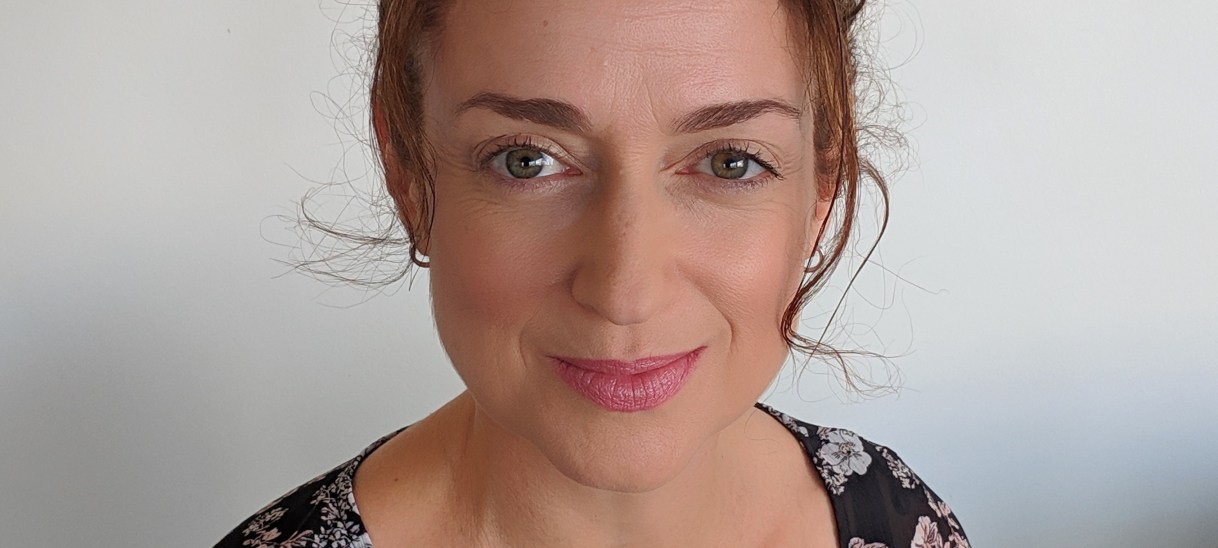
My name is Sandy and I am an author

I met with a financial advisor once – once. When he asked about my long-term plans (career, finances, retirement), I replied that I would probably never truly retire, because one day I’d be an author and I would continue to write ’til the day I stopped breathing.

He laughed at me. Out loud. Then he tilted his head and gave me a pitying look. I asked him to leave and went back to my desk and wrote a chapter.

That was in 2001.

I finished that manuscript, a travel biography of my year as a Contiki Tour Manager, then stuck it in a drawer. For years.

I dusted it off once and gave it to a writer friend. “This should be a novel,” she said, so I started turning it into a novel. In late 2012, I got 70000 words into a re-write, then queried it to an agent in Australia. He loved the first three chapters and immediately asked for the rest.

“This isn’t your first book,” he said on the phone a few days later. “It’s good – you’re an excellent writer – but you’re not Liane Moriarty. There are too many narratives, too many characters. Go and write a single narrative – a simple story. Then come back to me.”

Encouraged, I did.

Mining my own (sometimes interesting) life, I turned my true-life love story into a novel. I wrote You Might Meet Someone about a woman in her late-thirties, who – post-breakup – is fed up with men and takes herself on holiday to Greece, sailing the Cyclades Islands. Everyone tells her how she might meet someone – so condescending and unhelpful – but she just wants to travel and soak up the briny air and sunshine. Of course, she does meet someone – make that two someones.

(Aside: in real life, there was only one someone and he is still my someone.)

I went back to the agent. “Hi, do you remember me?” – that sort of thing. He did and said he’d read the first three chapters. Loved them and later that day, he asked for the rest. The next morning, well before I’d had my first cup of tea, I got the call. He’d read it twice and loved it. ‘Eat, Sail, Love,’ he called it.

He represented me for a year – per our contract – to no avail. No publishing deal. In retrospect, my synopsis and pitch were ‘off’, but my agent thought I should add some ‘danger’ to the book – apparently, danger was selling at the time. I wondered how I could do that. How could I turn a travel romcom into a book with danger? We parted ways amicably and I put the book in a (metaphorical) drawer. That was 2015.

In 2016 Ben and I had been together nearly 10 years and we decided to celebrate our real-life ‘meet cute’ with another sailing trip around the Greek Islands with the same skipper.

On return from that wondrous trip, I was inspired to pull out the book and give it another pass. “Why don’t you self-publish on Kindle?” asked my supportive love. I percolated on that question for a short while, gave the book a final edit, handed it off to a colleague with editorial chops, collaborated with a cover artist in London, and – bottom lip firmly between my teeth – published it on Kindle.

My book was out there. I was an author.

Fast forward to our sabbatical in 2018 and I wrote the sequel (also published on Kindle), then book three in the series. Sarah (books one and two) and her sister, Cat (book three), came to life. The men they loved, their travel adventures, their friendships, their internal battles, their journeys to love, came to life.

Concurrently, I soaked up as much as I could about author life. I took a course on building my author profile and engaged with fellow authors on Twitter. I read widely – both within my genre and about the business of being an author.

As I embarked on the indie author path, I tweaked and honed and finessed my pitches to book bloggers, agents and publishers. I joined author communities. I sought and gave feedback. I engaged beta readers and I became a beta reader – I learned what a beta reader is and why they are so important to the writing process. I entered contests and Twitter pitches, and was featured on book blogs and UKRomChat (hi, lovelies – I adore you so much!). I even did my first NaNoWriMo (National Novel Writing Month) and smashed it, writing 70000 words of my third book in three weeks.

I worked my little Aussie bum off.

Along the way, I made friends with some incredibly talented, generous, and supportive people – most of whom I’ve yet to meet face to face. I became part of the writing community.

Excitingly, my blood, sweat and lots of tears – a.k.a. ‘hard work’ – is now paying off. I have a new agent, the inimitable Lina Langlee of the Kate Nash Literary Agency in the UK, and she has secured me a two-book deal (!) with a soon-to-be-named imprint of a soon-to-be-named (big five) publishing house.

It’s happening. I am being published – by a world-renowned publisher.

I am embarking on a long-distance, long-term relationship with an agent who loves my work and believes in me, and a publishing house who described my writing as ‘beautifully sumptuous and evocative’.

So, as I commence writing my fourth book, as I assemble the dream cast for the movies of my books, as I continue to work in a field I (also) love and am great at – adult education – I am humbled, excited, terrified, vindicated, grateful, and … well, I am an author.

p.s. Doesn’t Lina Langlee have the best name ever?

p.s.p.s. If you read either of my first two books while they were out in the world, thank you. They’ll be back. (pssst, please leave a review on Goodreads)

p.s.p.s.p.s. Thank you to William (Bill) Aicher of the Indie Author CoalitionAimee Brown, fellow romance author and leader amongst women; DC Wright-Hammer, who shines the spotlight on fellow authors; Rebecca Langham, who started #AusWrites on Twitter (often the highlight of my day); Jeanna, Eilidh, Lucy and all my fellow authors of UKRomChat on Twitter (always the highlight of my romance author week); Allison and Valerie from the Australian Writers’ Centre; and Jen and Kerry from The Business of Books. Thank you Lindsey Kelk, my favourite author who (actually) replies to my emails. And thank you to my friend, Mike Curato, who took a leap of faith to become a best-selling artist and author.

p.s.p.s.p.s.p.s. Thank you Ben and my sis and my family and Lins and Jen and all my lovely friends. x


A desk with a view

We have now been on sabbatical for nine months, and during that time Ben and I have both worked for our respective clients and I’ve written, edited and published one novel and I’m about 1/4 of the way through writing the next.

While we’ve also made time to explore the different locations we’ve visited or lived in, our working life is a big part of the sabbatical. This is a test case: can we live and work abroad for extended periods of time? We never know, this could become our new normal.

The kind of work we both do – Ben developing software, and me writing and editing content – means we need to work at desks. But ‘desk’ can be any flat surface. Ben’s current stand-up desk set up is an ironing board and the box the vacuum cleaner came in – yes, really.

Most of the time, we either use the dining table of the place we’re staying at, or we go to coffee shops. The coffee shop thing is tricky. The seats have to comfortable enough to sit on for at least a couple of hours, the WiFi has to be good, the coffee can’t suck, and there needs to be a generally good ‘vibe’.

Our fave spot so far in Porto is the cafe at the Concert Hall, which has great seats, fast WiFi and a buzz of energy from the groups of people who gather there to catch up or to work. The coffee sucks, but 3 out of 4 isn’t bad. The other day, when it was still sunny and warm, we worked in the park at a picnic table for a couple of hours – divine.

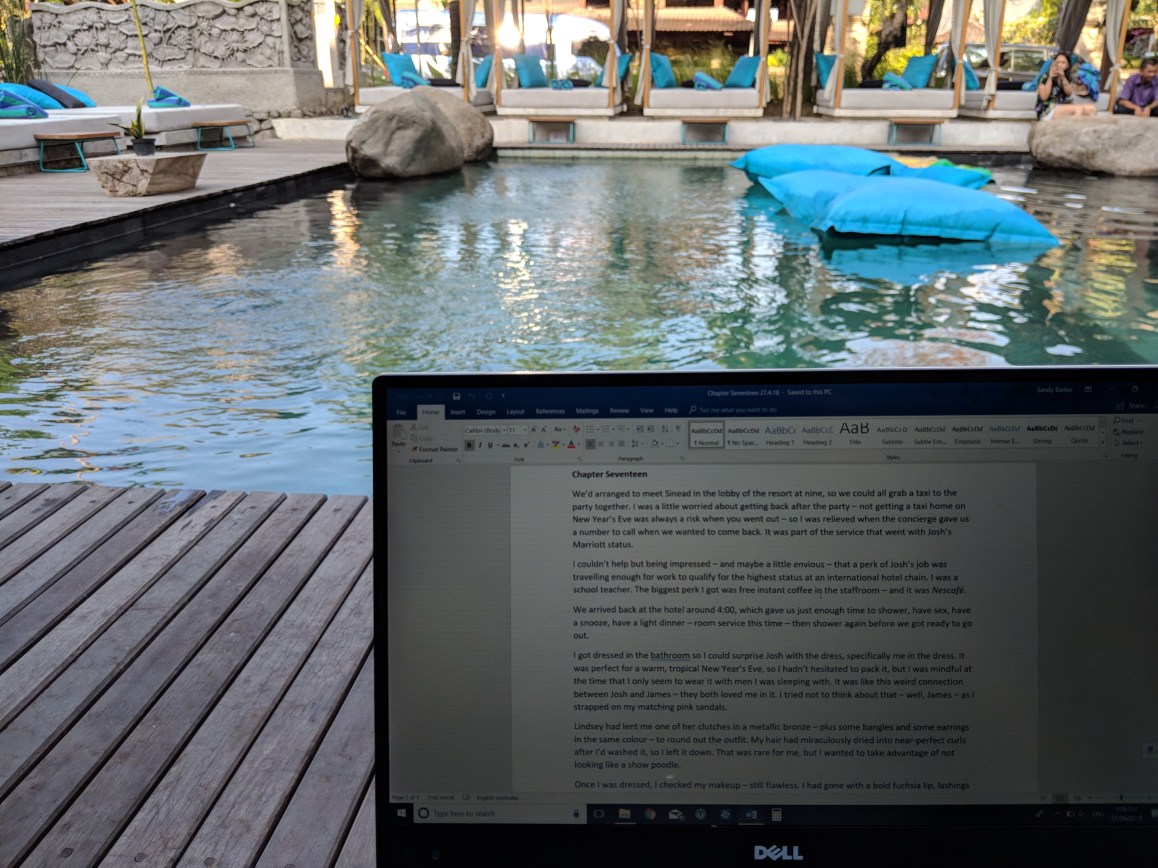
At the lake cabin, I’d often sit on the porch in an Adirondack chair (I love these) and write, stealing glances at the lake view from time to time. In Bali, my favourite place to work was on the sunlounger next to the pool.

So here are some of my fave desks with a view from the year so far.

In the park in Porto
At the park in Porto
Looking out the window in Amsterdam
Amsterdam


Drama Queen: Becoming a Novelist

Since I can remember, I’ve loved writing. I still have my Year 4 composition book and I was quite the short storyist (I also like to make up words). In my teens I wrote a gripping satirical piece on public toilets and started a novel (to date, still unfinished).

At university, while studying a BA in English and majoring in Literature and Theatre Arts, I wrote piercing exposes about sexism in classic novels and the sexualisation of men in Glam Rock – I know, also gripping stuff. I wrote angst-ridden monologues, which were somewhat sophomoric considering I was in my early twenties and no longer a sulking teen.

I kept a journal from age twelve, one of those small, but fat diaries with a gold lock that my eight year-old sister could easily pick. I upgraded to bigger and better journals, but stopped journalling about fifteen years ago when I realised I spent more time writing about my life than living it.

All of these writings and musings are where I cut my teeth as an author, but the one thing that has served me best as an author is Drama – my time studying performance and plays, my time on stage, and my time as a Drama teacher.

Drama taught me invaluable lessons I draw on every time I write.

Character motivations

Characters must have a motivation. It’s that simple. They must want something, even if they don’t (yet) know that they want it. Characters can also be their own antagonist – just think of how many people you know who self-sabotage. Any time my writing stalls, I ask myself, what does this character want and what will they do to get it?

Character arcs

Not only do characters need a motivation, they must move – and I don’t mean that they need to join a dance class or change their address. Characters – particularly the protagonist – must develop, grow, or change in some way. They must have an arc. They should be different at the end of the story from when the reader first meets them. It’s good for me as a writer to be able to articulate that continuum of growth, that arc.

Back stories

Acting taught me of the importance of back stories. Characters – again, particularly protagonists – need to be as fully fleshed out as possible. They should have histories and there should be reasons for their personality traits, their motivations, their flaws, their relationships. As a writer, I must create histories for my characters, so they ring true to readers.

Setting

In a play, there’s a great deal of attention to setting – how characters interact with it, how it’s referred to and how it is staged. On paper, a richly-developed setting can become almost a character in itself. And how characters engage with the setting can evoke a specific tone or mood. As I travel avidly, I tend to write about places I know well and aim to capture what it is like to be in those places.

Dialogue

I have received some terrific feedback on the realism of my dialogue, which I greatly appreciate because I tend to use a lot of it and I work hard to make it sound A) true to each character and B) natural and realistic.

Writing plays in the noughties helped me develop this skill. I was teaching at a girls’ school and was seeking out plays for student productions. There’s a dearth of well-written, easy-to-stage ensemble pieces which are appropriate for high school students – especially for an all-female cast. So, I wrote plays. (They have since been published on Drama Notebook in the US and have been performed by schools in Australia, the UK and the US.)

I also hone this skill every time I work on one of my novels. Once I finish a conversation, I read it aloud as the characters (with voices – I can’t help myself), and tweak the phrasing, words, tone and inflections. My aim is to make it seem like a real conversation that I happened to capture in print.

Scenes

I follow a lot of authors on social media through Twitter, Facebook, blogs and websites, and I’ve been pleased to see more and more discussions about writing in scenes. Rather than focussing on chapters, the author focuses on a scene where something specific happens – just like in a play. A scene could comprise a whole chapter, or it might be part of one.

I realised recently that as a novelist I always write in scenes – again, perhaps a throw-back to writing plays. It is easier for me to approach the over-arching story in smaller, self-contained chunks. As a reader, I’ve seen a shift in writing towards this format. Likely you’ve seen this too – authors denote the end of a scene within a chapter with a double space or a physical page break that looks something like this:

***

Where I used to have to finish reading a whole chapter before putting a book down, I can now get to the end of a scene and feel like I have a natural place to pause.

A quick nod to grammar

I mentioned that I studied Literature as well as Theatre Arts and it was through my Lit classes that I began my love affair all things grammar. I have since taught English and worked as a professional editor. It means I can conduct decent and thorough editorial passes at my own writing before handing off to a(nother) pro (always get another pair of eyes on a manuscript).

And a quick nod to my contemporaries

A good writer reads. A good writer reads widely. A good writer reads voraciously.

Reading teaches you what to do and what not to do – how to evoke time, place, passion, fear, love, loss and the human condition – how to avoid over-using a word – how to structure a phrase, a sentence, a chapter, a thought – how to make your readers laugh aloud and weep onto the page – how to play with words and ignore the rules for effect.

I want to be a good writer – sorry, make that a great writer – so I read. Every day. Across genres. Indie authors, emerging authors, well established authors, and sometimes super famous authors.


How to write a sequel

Maker:L,Date:2017-9-28,Ver:5,Lens:Kan03,Act:Kan02,E-Y

I originally posted this while writing the follow up to One Summer in Santorini. It is 14 months on, and I have edited this post accordingly.

I begin this post by planting my tongue firmly in my cheek. I would love to say that I’ve unlocked the secret, that I’ve discovered the Holy Grail of writing, that I’ve figured it out! In truth, I have discovered a kind of secret sauce for myself. Other writers may benefit from my ‘process’, so if anything I say resonates, have it – it’s yours.

Reflect on book one

I wrote book one, One Summer in Santorini, for several reasons:

  • My previous agent told me that the book I was writing at the time was my 5th book, not my 1st – too many characters and a multi-narrative. “You’re not Liane Moriarty,” he said. “Yet,” he added. He then challenged me to write a simple, linear narrative. Which I did.
  • It was a love letter to my partner, Ben. We met in Greece and I borrowed (rather heavily) from our story for the book  – the first half anyway. When I introduced a love triangle I was well into the realm of fiction.
  • It was a love letter to Greece. Greece is a place where you go to fall back in love with yourself – and with being alive. It challenges you to participate in your own life. If you haven’t been, go.
  • I had some demons to exorcise. I was single for half my twenties and most of my thirties. And by ‘single’ I mean I dated awful men who I changed or hid myself to be with. I wanted to write about a woman who calls an end to that, who won’t compromise herself again to be with someone.

Make time

I wrote book one on weekends and on evenings after working at a full-time job where I spent the bulk of my time writing. It was often hard to come home (usually post gym or errands) and sit down and write for myself. I did it, but it took a couple of years.

For the sequel, I had time. In 2018, we were on a year-long sabbatical. I had contract work, but I could dedicate significant chunks of time to writing. I started writing the sequel in February while we were still in Australia and I hit 10,000 words. I was reasonably happy with that progress, but my goal in Bali was to up the pace. After 8 weeks there, I finished the book at about 95000 words.

Celebrate the milestones

Every writer gets to decide what each milestone is. I celebrated when I got through an emotional part (if the writing left me sobbing or laughing out loud – milestone!), or I finished a chapter. The sequel is written in parts – and finishing each one was a milestone. Celebrating, by the way, included sharing on social media, pedicures, cocktails, massages, and congratulatory hugs from Ben.

The secret sauce

With book one, I had to knuckle down. I had to carve out time, and often had to force myself to sit down and write or edit or proofread. I had to self-impose deadlines and get others to hold me to account.

Being in Bali, with the luxury of time, the portability of a laptop, and being inspired by my surroundings, I had an absolute ball writing the sequel. And I worked faster, which meant there was continuity in the writing – the style, the voice, the narrative, character development. I had to work laboriously at that in the editing process of One Summer in Santorini, because I wrote it over such a long period of time. With the sequel, I’ve made the editing process easier on myself, just by writing over such a concentrated amount of time.

Most importantly, though, I let the story come to me.

This is the hardest part to explain, and is still my process. I start with only a rough outline, and I have no idea how many chapters it will take to tell the story. For the sequel, I didn’t even know how it ended when I started writing it.

When I got stuck, or I didn’t know what would come, I stepped away – sometimes for a few hours, sometimes days, and when I was doing something else – running, cooking, dodging scooters on the road – it came, the next part of the story. Then I would sit and write.

I’m so grateful that we made this decision to pack up our lives, sell up our stuff, leave our jobs and to live around the world. It was my special not-so-secret-anymore sauce.

While on sabbatical, I also wrote another follow up to One Summer in Santorini about Sarah’s sister, Cat. This book will be out early next year with the sequel to follow.

I Think I Met Someone (Book 2 in the ‘Someone’ Series)

The sequel to You Might Meet Someone picks up Sarah’s story a few months after her Greek adventure.

Here’s the preface…

“Have a great time!” my best friend, Lindsey, called as she climbed into the driver’s seat of her car.

“I hope he shows up,” said her husband, Chris, grinning at me through the passenger window. Chris always teased me. He was the brother I always knew I never wanted.

“Ha, ha. You’re hilarious.”

Lins leaned across Chris, swatting at him as though he were a naughty fly. “Ignore my horrendous husband.” Chris grinned at me. “He’ll be there. And you’ll have a ball.”

I nodded, clinging to her words of encouragement. I needed them.

“We love you,” she said with a smile. Chris winked at me.

“Love you back,” I said as I waved goodbye. The car pulled away from the curb and I took a moment to catch my breath.

To be honest, I was only mildly terrified that he wouldn’t show up, and that I’d be sitting in a hotel room half-way across the world by myself. Self-doubt can be such a buzz-kill, especially when you’re about to fly somewhere you’ve never been before, to meet up with someone you haven’t seen in months.

What if he didn’t show up? Or, what if he did, but it wasn’t the same between us? Oh my god! What was I doing?

The hardest part is getting published

Writing a novel may seem like a big task. It is.

Start to finish, including chapter re-writes, incorporating feedback from trusted editors and reviewing the whole thing 3 times over, You Might Just Meet Someone took about 2 years. That’s 2 years alternating between intense labouring and equally intense procrastination.

You see, I love to write, but I don’t always feel like doing it. The majority of my job is writing – documents, training materials, reviews, editing – so when I get home from work, sometimes I don’t want to sit in front of another computer and do more writing. And of course when I get in the habit of browsing Reddit, watching Netflix or reading instead of writing regularly, it is easy to ignore the niggling voice in my head that says, “Sandy, this novel is not going to write itself.”

Well, it’s done now, and I have already started the outline for the sequel, but harder than writing and editing it, is getting it published.

Just like a novel doesn’t write itself, no one is going to knock on my door and say, “hello, I’m looking for a novel to publish. Do you happen to have one lying about in a drawer somewhere?”

No! It’s up to me. I have to get the word out!!

I need a publisher, or an agent, or both. Whichever one I get first will (probably) make it easier to get the other one, so I am working on getting a publisher and an agent at the same time. It’s a bit chicken and egg, really.

And you may not know this, but an aspiring author needs a brilliant book proposal, one that can be adapted for each potential publisher and agent, because they all want slightly different things.

Essentially, I need a detailed synopsis, a shorter synopsis, and a really brief synopsis – something that might appear on the back cover. Plus I need an engaging author’s bio which highlights my brilliance and my bankability, and to identify the target audience as well as competing titles – these are the books mine will sit next to on the shelf. Publishers and agents need to know what books are similar to mine – and in what way – as well as how mine is distinctive from other books.

I learned all of this from two incredibly brilliant women, Kerry and Jen from the Business of Books based out of Seattle. Between them they have written (and published) 40+ books, and because they both worked as publishers before they became authors they really know the biz of books. And they share what they know.

Publishing is a business and if I am going to make it my business, I still have work to do. Now begins the hard part.


The Next Big Thing

I am cheating a little in posting this meme, as I was not tagged by the author who I follow via her blog, Charlotte’s Web, and that is part of the meme’s premise. That said, Charlotte Otter – a South African writer who lives with her family in Germany – has often inspired me to put pen to paper (‘finger to keyboard’ doesn’t quite sound right, does it?). I recommend checking out her blog, and when it is published, her novel. Simply, she is an exceptional writer.

This meme is timely for me, as I just submitted a well-honed draft of my book proposal to Jen and Kerry of the Business of Books for editing. They promise a return of the draft by December 1st and in the meantime I keep chipping away at the novel itself. I have been writing (almost) every day for two months now. Looking back over my calendar, I have only taken four ‘vacation’ days from writing, and I am benefiting greatly from the momentum. As Timothy McSweeney says in his Ultimate Guide to Writing Better Than You Normally Do,  writing is a muscle. I am pleased to say that I am getting some decent mental biceps from the consistent writing. I should note that not everything I write is always literally gold, but that’s what revisions are for.

The idea of this is that a writer puts up a post on his or her own blog answering ten questions about his/her work in progress, and then “tags” other writers to do the same. Then, the writer posts a link to his/her “tagger” and to the people he/she is “tagging” so that readers who are interested can visit those pages and perhaps discover some new authors whose work they’d like to read.

So, here we go…

What is the working title of your book?

All Over the Map. Previous working titles have include The World Ate My Oyster and Desperately Seeking Sarah, but I like this latest one best. And it came about organically while I was discussing the plot with Ben. I said, “She’s all over the map – literally,” and we both paused taking it in. “That should be the title,” he said, simply. And I agree.

Where did the idea come from for this book?

A decade ago I wrote several drafts of a travel biography. One of the people I handed it to was Simonne Michelle-Wells, who said, “This should be a novel. You need to re-write this as fiction.” I resisted for years and then made a half-hearted effort to write it as a novel a couple of years ago. I came back to it with renewed love and determination this year. So, now it is a novel.

What genre does your book fall under?

Contemporary women’s fiction. Some would say ‘chick lit’ which I am not adverse to. It is not a cutesy as quite a lot of chick lit, but it is a novel for and about women.

Which actors do you have in mind to play in the movie of your book?

I have a dear friend in Australia who is an exceptionally talented actress, Lisa Adam, and I have often pictured her as the protagonist, Sarah (who is an Aussie). I think this film would be cast with some fresh faces.

What’s the one-sentence synopsis of your book?

I agree with Charlotte. This is hard.

Sarah, an Australian living in London, is devastated by the end of her seven-year relationship, and seeking a way to get on with her life, takes a job as a Tour Manager leading fellow travelers on tours around Europe.

(serious run-on sentence)

Will your book be self-published or represented by an agency?

I hope to have it represented by an agency, hence the book proposal. There is a lot of merit in considering self-publication and I am studying up on that – just in case.

How long did it take you to write the first draft of the novel?

The first draft of the travel biography, a few months – all hand-written. The first draft of the novel will take longer, as although there is good source material, I am inventing, amalgamating and re-crafting the tone and style. In the past two months I have drafted a third of the novel. This has included three total passes.

Which other books in this genre would you compare to your novel?

Marion Keyes, Maggie Alderson and Jennifer Weiner write novels that I’d like mine to sit next to in the bookstore.

Who or what inspired you to write this book?

My own experiences with a break-up, living in London and being a Tour Manager.

What else about your book might pique a reader’s interest?

Humor. I inject humor so as to reflect real life. Stories can’t be all misery, or all joy. Also, I am working especially hard on the characters. I want readers to recognize people they know from their own lives.

Who to tag?

Megs Thompson. I met her at the Whidbey Island Writers’ Retreat. She is dynamic and clever and I love the concept of the novel she is writing.

Simonne Michelle-Wells. I am not sure what Simonne is currently working on – she has been blogging quite a lot lately.

You’re it.

A (writing) contract with myself

Six weeks ago I enlisted the help of a dear friend and fellow writer, Jen, to hold me to the terms of a contract. I drew the contract up myself – no, I am not suddenly a lawyer – so that I would be accountable for working as a writer. I got this idea from Aimee Bender’s article in Oprah, Why the Best Way to Get Creative Is to Make Some Rules, which  you should really check out if you are a writer, or you want to hold yourself to any sort of disciplined pursuit. Around the same time, I also came across this article in Redbook by Sandy M. Fernandez, Join the Accountability Club.

Both articles give great advice:

  • Set a clear, attainable goal
  • Tell others about it
  • Ask them to hold you accountable for attaining your goal
  • Check in regularly
  • Attain goal

Voila!

So, with these two great minds in mind I created my writing contract, phase one of which concludes today. It goes a little something like this:

Dates: September 17th to October 31st 2012 (1 ½ months)

Conditions:

  • Write every day for minimum of one hour
  • Can include: Book proposal; Book revision/new content; Blog post
  • Permitted: 5 ‘vacation’ days
  • Aim for 12 hours per week
  • Check in with Jen every day via text message: “Done” = completed at least one hour; “Vacation” = took the day off
  • Jen replies “Check” for each message

I am happy to report that I took only 3 vacation days, two of which were while I was actually on vacation in Napa Valley, and the last one was on the day I hosted a dinner party for 25 people.

I am also happy to report that I aimed for an hour a day, but averaged 2.5!

I am further happy to report that writing is now something I now do every day, because I am not only accountable to Jen, but more importantly to myself. As a result, I have completed a total overhaul and re-draft of part one of my novel. I started with a travel (auto)biography and now I have a work of fiction. In home renovation terms, I tore done all the internal walls until I was left with just the foundation and some structural support and completely rebuilt, refurbished and redecorated it.

I am additionally happy to report that I am close to having a dynamic, well-crafted book proposal completed. This will then go out to agents and publishers.

I am lastly happy to report that Jen and her hubby Nate welcomed their baby daughter, Ellie, nearly a week ago. And brilliant as she is, Jen was still my accountability bud while in labor and just after Ellie’s birth – a her own insistence.

Many, many thanks to Jen and to the other writers I  have in my life for your unwavering support and encouragement. Thank you to my non-writer friends and family members who have liked my Facebook updates on the progress, and support my endeavor to finish this novel. And thank you to Ben and Lucy for allowing me to lock myself away for hours at a time.

Nearly there…

Whidbey Island Retreat

The night was dark and stormy…

Saturday night I was snuggled in my little corner room of the Captain Whidbey Inn while a storm raged outside. A screen door on the ground floor kept slamming in the wind, waking me throughout the night. Fellow guests had talked about the two ghosts that haunt the inn while we ate dinner.


But I wouldn’t have traded places with anyone – not even my boyfriend who was winging his way to sunny Australia.


I was on retreat, and what better place to lock yourself away for a weekend of writing than an old inn on the water, and backing onto the forest?


What an incredible weekend! I was part of a wonderful group of creative women, Anne, Thea, Lea, and Beverley and we had three incredible writing workshops with three diverse and exquisitely talented authors:

Stephanie Kallos

Bharti Kirchner

and Terry Persun

As well as my immediate group, I also met Megs, Kate and other gifted and passionate writers. I loved the collaboration, the camaraderie and the incredible amount that I learned. I have seen my own work with a renewed and critical eye, which means I can take another pass at it with particular attention to the following:

  • Differentiation of character (there are a lot of women in my book – are they all distinctive from each other, or do they bleed into one?)
  • Fleshing out the antagonists (‘bad guys’ have feelings too!)
  • P.O.V. shifts (oops – slap my hand)
  • Setting (the oft-neglected child)
  • Depth (short-shrifting the reader will only piss them off – thanks Stevie!)

Bharti made this great point that some authors get to the end of their book and realize that the characters never eat. Mine eat, but it is a detail that can evoke setting really effectively, so I need to ensure that I have given it the right amount of attention. Much of my action in part two takes place on a coach and I know that I can spend more time on developing the sense of claustrophobia that develops on a six-week trip. Stephanie told me that chapter one intrigued her, but that she was pissed off because I start after the crucial, catalytic moment. This is a great point! I am now working on a prologue to see if that addresses the issue. Of course, chapter one, which I am in love with by the way, will now need a major re-write. Terry’s workshop highlighted for me that one-note characters are boring. My villain in part two needs nuances and I have just the scene to bring his out.

I am so very excited to get to work. And I have a hell of a lot of it to do!


Retreating to move ahead

Today I will be retreating to Whidbey Island for their Writers’ Association “Lockdown” Retreat. I will be locking myself away (voluntarily) with other writers – authors and poets – for two-and-a-half days on my absolute favorite of Puget Sound’s many islands.

My aims:
•    To get some ‘objective’ feedback on my book (the people attending don’t know me, so can only react to what is on the page)
•    To engage in meaty conversations about writing, prose, poetry and all things literary
•    To spent the weekend wearing Ugg boots and big chunky sweaters, drinking tea and whiskey (not at the same time)
•    To write, write, write
•    To learn everything there is to know about everything
•    To be challenged to be more innovative, more creative and to stretch myself artistically
•    To learn more about the business of books
I am retreating to move forward. I can’t wait.