Write what you know, right?

In the late 90s, I was a European Tour Manager for a company that specialised in tours for 18-35 year olds. See?

EE 1997-No Contiki

Aside: Gotta love those ‘mom jeans’.

I always said I would never go on one of these tours, let alone work as a TM, but when you have a devastating breakup in Paris from a 5-year relationship and you still want to see all the places you were supposed to see on that trip with your now ex-boyfriend, you book a last-minute tour.

After said Parisian breakup, I arrived home (in London) on the Eurostar, got on the phone, and booked a 2-week trip that started the next morning at 7am. I was back in Paris within 24 hours of leaving and on that trip, I met 5 women who became my bus besties. I am still in touch with Michelle, the tall blonde.

Venice 1996

Months later, while I was living in London and doing day-to-day relief teaching, I saw that the tour company was hiring. “I could do that job,” I thought. I applied, along with a couple thousand others, and after an interview process that would NOT pass muster in this #metoo world, I got a spot on the 7-week training trip.

Surviving that was like getting to the final four of Survivor. It was something akin to bootcamp, but with less creature comforts. We averaged 4-5 hours of sleep a night and we slept in tents – in winter – in the snow. We were quizzed relentlessly on routes, opening times, history, currency conversion, places of interest, and architecture. I made lifelong friends, because, really, in the extreme circumstances, all we had some days were each other.

And then I was placed in charge of my own tour – a 5-week camper – the first of a long season that took me into November. It was one of the best and worst years of my life. The best because of the friendships I made, the places I saw, and the experiences I had. And the worst because … well, that’s another blog post.

But, one of the most incredible things about that time is the material it has given me for my writing.

In my 1st and 3rd books, the main character is Sarah Parsons, and like me, she once ran tours in Europe. When her sister, Cat (the main character is book #2), books a 2-week bus tour around around Europe to escape her lovelorn flatmate, Sarah is able to rattle off the full itinerary without hesitation.

And Cat booking that tour meant that I got to write a 2-week bus tour around Europe!

Cat’s 3 bus besties are inspired by my real life bus besties. Michelle inspired Mama Lou, Weyleen (far left above) inspired Jaelee, and Sophie (second from the left) inspired Danielle. I was able to write the places in great detail, because I’d been to them many (many) times. And I was able to write exactly what it’s like to travel on a bus tour – right down to the (ridiculously) early starts, the heinous ablution blocks, the tight schedules, the fast-but-firm friendships that are formed, and how wonderfully Europe excites and entices the senses.

Here’s a little peek into that world…

It was brilliant fun writing That Night in Paris. Early readers are loving it, and you can preorder now (April 15 for the ebook and June/July for the print version) – just follow the link above.

Ciao!
How to write a sequel

Maker:L,Date:2017-9-28,Ver:5,Lens:Kan03,Act:Kan02,E-Y

I originally posted this while writing the follow up to One Summer in Santorini. It is 14 months on, and I have edited this post accordingly.

I begin this post by planting my tongue firmly in my cheek. I would love to say that I’ve unlocked the secret, that I’ve discovered the Holy Grail of writing, that I’ve figured it out! In truth, I have discovered a kind of secret sauce for myself. Other writers may benefit from my ‘process’, so if anything I say resonates, have it – it’s yours.

Reflect on book one

I wrote book one, One Summer in Santorini, for several reasons:

  • My previous agent told me that the book I was writing at the time was my 5th book, not my 1st – too many characters and a multi-narrative. “You’re not Liane Moriarty,” he said. “Yet,” he added. He then challenged me to write a simple, linear narrative. Which I did.
  • It was a love letter to my partner, Ben. We met in Greece and I borrowed (rather heavily) from our story for the book  – the first half anyway. When I introduced a love triangle I was well into the realm of fiction.
  • It was a love letter to Greece. Greece is a place where you go to fall back in love with yourself – and with being alive. It challenges you to participate in your own life. If you haven’t been, go.
  • I had some demons to exorcise. I was single for half my twenties and most of my thirties. And by ‘single’ I mean I dated awful men who I changed or hid myself to be with. I wanted to write about a woman who calls an end to that, who won’t compromise herself again to be with someone.

Make time

I wrote book one on weekends and on evenings after working at a full-time job where I spent the bulk of my time writing. It was often hard to come home (usually post gym or errands) and sit down and write for myself. I did it, but it took a couple of years.

For the sequel, I had time. In 2018, we were on a year-long sabbatical. I had contract work, but I could dedicate significant chunks of time to writing. I started writing the sequel in February while we were still in Australia and I hit 10,000 words. I was reasonably happy with that progress, but my goal in Bali was to up the pace. After 8 weeks there, I finished the book at about 95000 words.

Celebrate the milestones

Every writer gets to decide what each milestone is. I celebrated when I got through an emotional part (if the writing left me sobbing or laughing out loud – milestone!), or I finished a chapter. The sequel is written in parts – and finishing each one was a milestone. Celebrating, by the way, included sharing on social media, pedicures, cocktails, massages, and congratulatory hugs from Ben.

The secret sauce

With book one, I had to knuckle down. I had to carve out time, and often had to force myself to sit down and write or edit or proofread. I had to self-impose deadlines and get others to hold me to account.

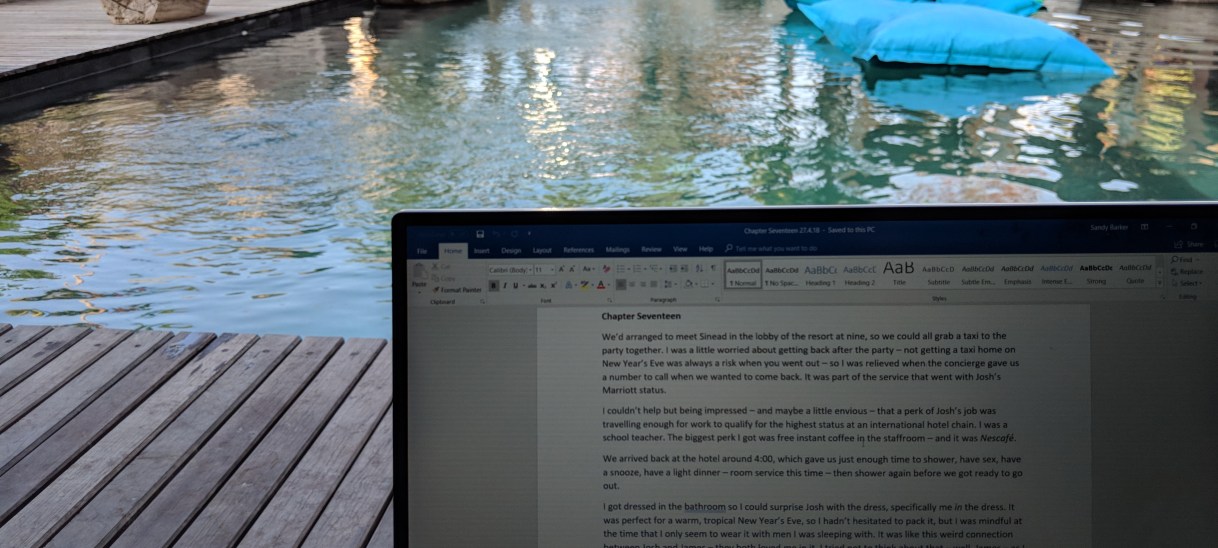
Being in Bali, with the luxury of time, the portability of a laptop, and being inspired by my surroundings, I had an absolute ball writing the sequel. And I worked faster, which meant there was continuity in the writing – the style, the voice, the narrative, character development. I had to work laboriously at that in the editing process of One Summer in Santorini, because I wrote it over such a long period of time. With the sequel, I’ve made the editing process easier on myself, just by writing over such a concentrated amount of time.

Most importantly, though, I let the story come to me.

This is the hardest part to explain, and is still my process. I start with only a rough outline, and I have no idea how many chapters it will take to tell the story. For the sequel, I didn’t even know how it ended when I started writing it.

When I got stuck, or I didn’t know what would come, I stepped away – sometimes for a few hours, sometimes days, and when I was doing something else – running, cooking, dodging scooters on the road – it came, the next part of the story. Then I would sit and write.

I’m so grateful that we made this decision to pack up our lives, sell up our stuff, leave our jobs and to live around the world. It was my special not-so-secret-anymore sauce.

While on sabbatical, I also wrote another follow up to One Summer in Santorini about Sarah’s sister, Cat. This book will be out early next year with the sequel to follow.

Write now!

I want to get back to writing my book.  Let me qualify that: I need to get back to writing my book.

My book starts as a series of journal entries (both personal and travel) and letters in 1996 and ‘97, long before I know I will write a book.

In 2001, I start writing chapters, by hand.  The chapters flesh out story snippets and descriptions of people and places.  The chapters expound on inner turmoil, extreme loneliness and a budding thirst for a less-ordinary life.

By the end of 2001, I am typing these chapters into a computer, adding more details, more perspective and more poetry to my word count.

I print out what I consider the second draft and edit onto the pages.  Like the cliché that I am, I carry dog-eared pages with me everywhere, reading and re-reading the story of me.  My book, a travel biography, begins to take shape and I move chapters, fool around with format and finally settle on a 3-part tome.

Part One. Narrative. Documenting the end of life as I know it.  My alone-ness.  My fear of drowning.  My knowledge that doing something, anything, is better than doing nothing.  Not knowing what ‘something’ to do.

Part Two. Narrative.  A journey in a wide circle.  Defeat.  Triumph.  Forging relationships.  Learning that I don’t know everything.  Learning that I know a lot.  Drinking in facts and places and more people.

Part Three.  Episodic.  The circles continue, concentric, overlapping, my life a Venn diagram.  Hating myself.  Loving myself.  Losing myself to excess and pretended celebrity.  Stillness.  Silence.  Sleep and a momentum that ultimately forces a new trajectory.

Years pass.

I occasionally dust off a printed copy.  What draft is this?  Eight?  Eleven?  I lose track.

“I am in love with this,” says a friend.  “But it should be a novel.  It should be in the third-person.”  I disagree, and re-write chapter one for the fifty-millionth time.  Each time I re-write it I love it more.

“It’s wonderful, Sweetie,” says my mother.  “She has to say that,” I think.  But she actually does love it.

I feed it in cruel increments to willing and select friends.  I want critics, not sycophants to read it.  Only that will make it better.  I write in sporadic and manic phases.  I accomplish much, then nothing for months, years.

In 2009, I sit in modest, yet well-decorated apartment in a foreign city, and I read chapter one.  “This should be a novel, in the third-person,” I think and I smile.  It has taken me years to get to this point.  I tell my friend, herself a writer, a successful one.  She is pleased.

I dig out the letters and journals from a decade before, all brought from my homeland for this very purpose, and I read.  I remember a girl I once knew, one who loved passionately and had her hopes crippled.  I think of her fondly as I might think of a distant relative I was once close to.  She saddens and angers me, yet I know I will always be protective of her.  She is, after all, me.

I return to the keyboard, and I start at the beginning, a very good place to start.

Chapter one.

I write the story of a young woman called Sarah.  She has a whole life, most of which I have yet to discover and some of which echoes my own life.  I love her, as fiercely as I love the girl in the journals and hand-written lengthy letters collected by loving parents and returned years afterwards.

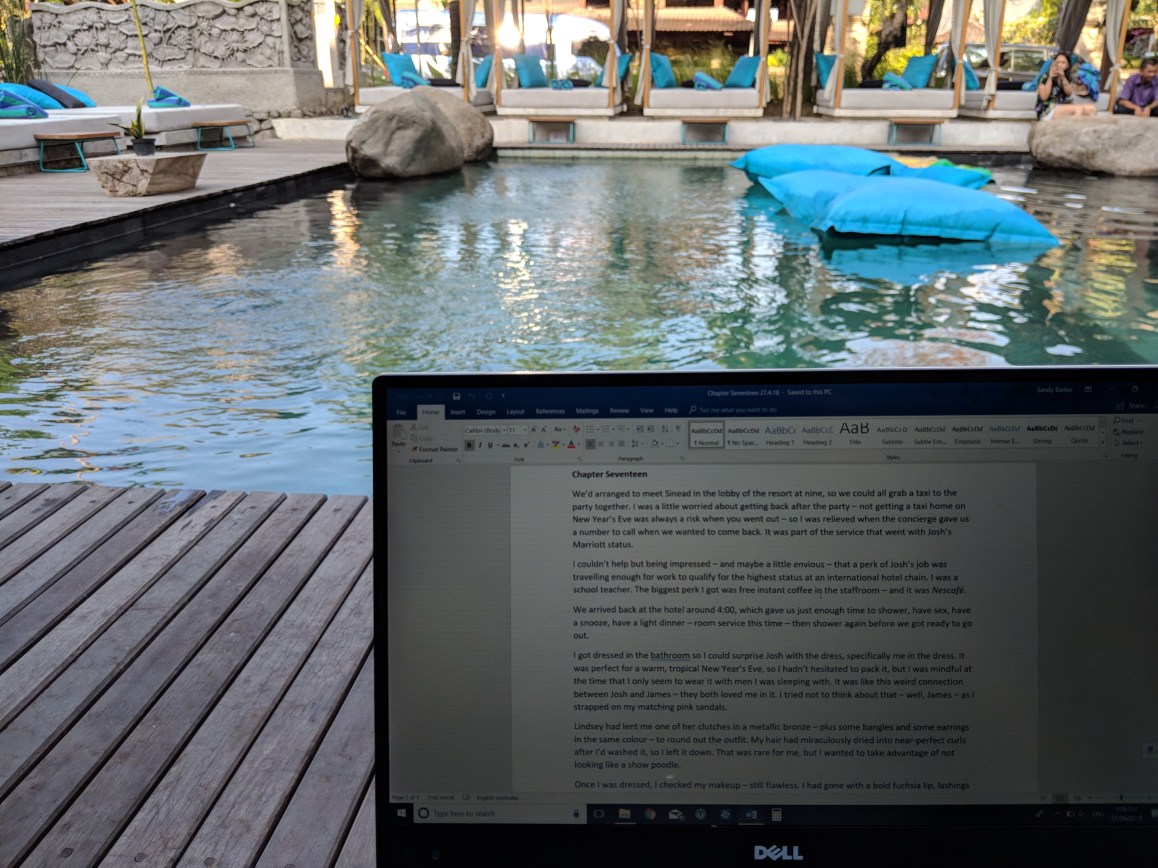
I feed it to a new friend in meaty chunks.  She wants more.

It flows out of me, like a mother’s milk.  Chapter one.  Two.  Three.  Six.  And then, nothing.

Months later I return to the pages I wrote and do not recognize the words.  “Who wrote this?” I wonder and then remind myself that I did.  These words are mine.  And they are good.

Yes, I need to get back to my book.