A desk with a view

We have now been on sabbatical for nine months, and during that time Ben and I have both worked for our respective clients and I’ve written, edited and published one novel and I’m about 1/4 of the way through writing the next.

While we’ve also made time to explore the different locations we’ve visited or lived in, our working life is a big part of the sabbatical. This is a test case: can we live and work abroad for extended periods of time? We never know, this could become our new normal.

The kind of work we both do – Ben developing software, and me writing and editing content – means we need to work at desks. But ‘desk’ can be any flat surface. Ben’s current stand-up desk set up is an ironing board and the box the vacuum cleaner came in – yes, really.

Most of the time, we either use the dining table of the place we’re staying at, or we go to coffee shops. The coffee shop thing is tricky. The seats have to comfortable enough to sit on for at least a couple of hours, the WiFi has to be good, the coffee can’t suck, and there needs to be a generally good ‘vibe’.

Our fave spot so far in Porto is the cafe at the Concert Hall, which has great seats, fast WiFi and a buzz of energy from the groups of people who gather there to catch up or to work. The coffee sucks, but 3 out of 4 isn’t bad. The other day, when it was still sunny and warm, we worked in the park at a picnic table for a couple of hours – divine.

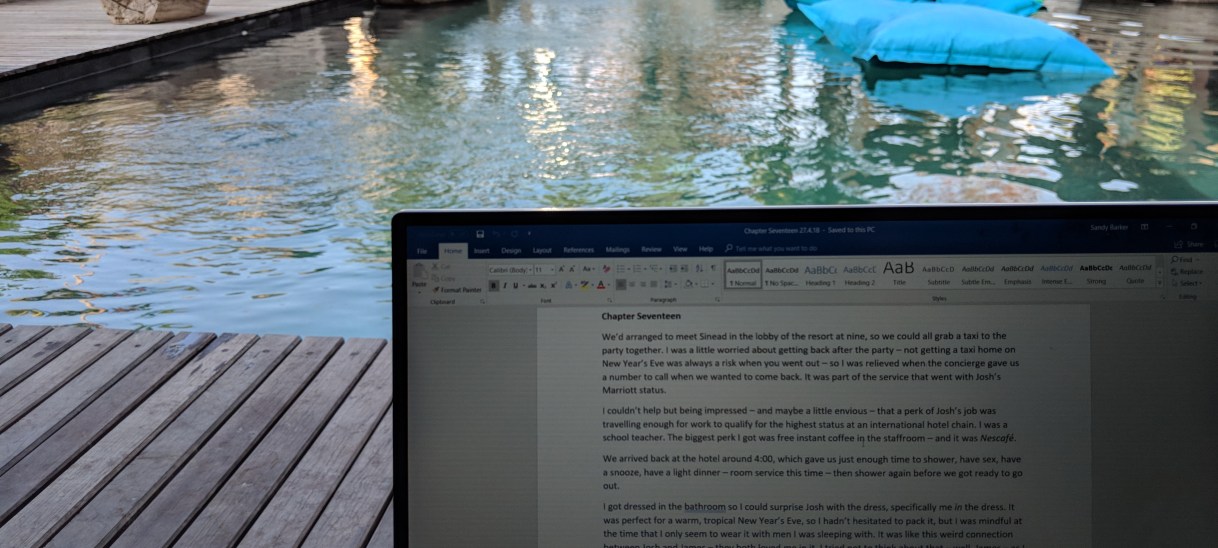
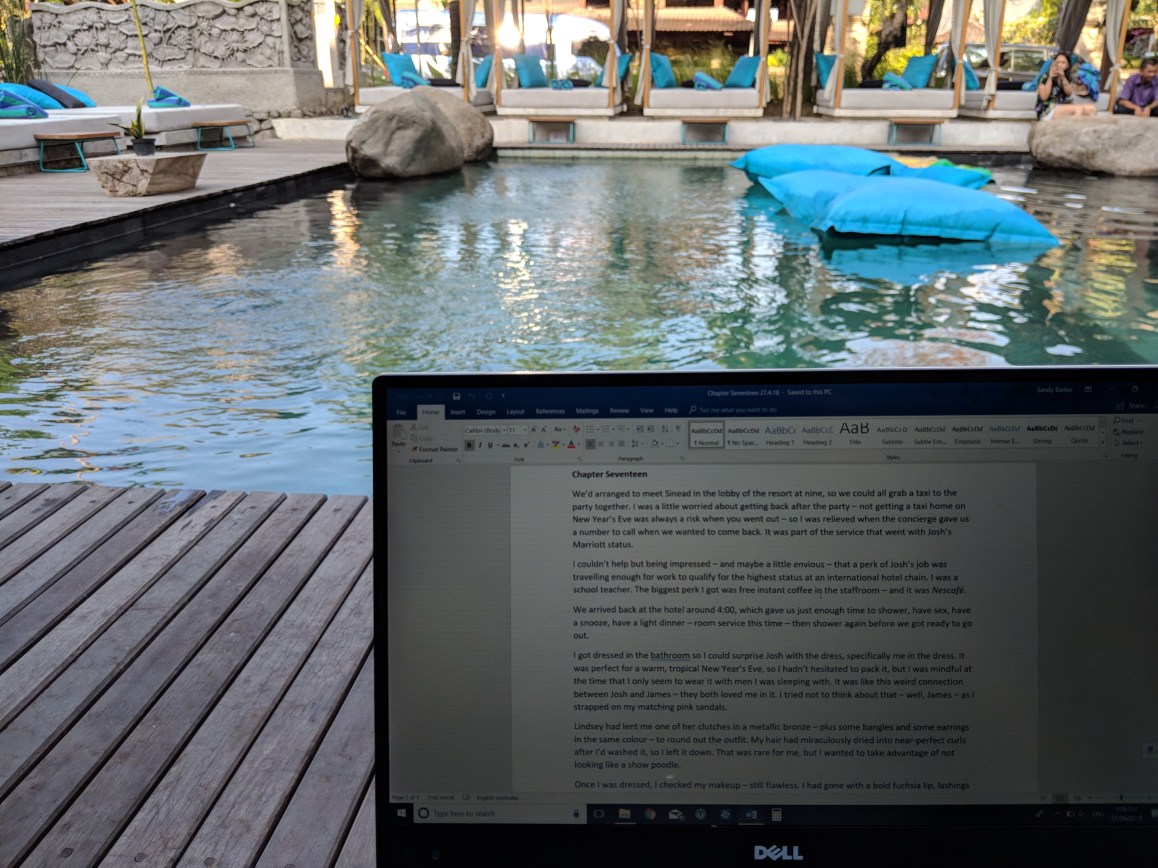
At the lake cabin, I’d often sit on the porch in an Adirondack chair (I love these) and write, stealing glances at the lake view from time to time. In Bali, my favourite place to work was on the sunlounger next to the pool.

So here are some of my fave desks with a view from the year so far.

In the park in Porto
At the park in Porto
Looking out the window in Amsterdam
Amsterdam


Drama Queen: Becoming a Novelist

Since I can remember, I’ve loved writing. I still have my Year 4 composition book and I was quite the short storyist (I also like to make up words). In my teens I wrote a gripping satirical piece on public toilets and started a novel (to date, still unfinished).

At university, while studying a BA in English and majoring in Literature and Theatre Arts, I wrote piercing exposes about sexism in classic novels and the sexualisation of men in Glam Rock – I know, also gripping stuff. I wrote angst-ridden monologues, which were somewhat sophomoric considering I was in my early twenties and no longer a sulking teen.

I kept a journal from age twelve, one of those small, but fat diaries with a gold lock that my eight year-old sister could easily pick. I upgraded to bigger and better journals, but stopped journalling about fifteen years ago when I realised I spent more time writing about my life than living it.

All of these writings and musings are where I cut my teeth as an author, but the one thing that has served me best as an author is Drama – my time studying performance and plays, my time on stage, and my time as a Drama teacher.

Drama taught me invaluable lessons I draw on every time I write.

Character motivations

Characters must have a motivation. It’s that simple. They must want something, even if they don’t (yet) know that they want it. Characters can also be their own antagonist – just think of how many people you know who self-sabotage. Any time my writing stalls, I ask myself, what does this character want and what will they do to get it?

Character arcs

Not only do characters need a motivation, they must move – and I don’t mean that they need to join a dance class or change their address. Characters – particularly the protagonist – must develop, grow, or change in some way. They must have an arc. They should be different at the end of the story from when the reader first meets them. It’s good for me as a writer to be able to articulate that continuum of growth, that arc.

Back stories

Acting taught me of the importance of back stories. Characters – again, particularly protagonists – need to be as fully fleshed out as possible. They should have histories and there should be reasons for their personality traits, their motivations, their flaws, their relationships. As a writer, I must create histories for my characters, so they ring true to readers.

Setting

In a play, there’s a great deal of attention to setting – how characters interact with it, how it’s referred to and how it is staged. On paper, a richly-developed setting can become almost a character in itself. And how characters engage with the setting can evoke a specific tone or mood. As I travel avidly, I tend to write about places I know well and aim to capture what it is like to be in those places.

Dialogue

I have received some terrific feedback on the realism of my dialogue, which I greatly appreciate because I tend to use a lot of it and I work hard to make it sound A) true to each character and B) natural and realistic.

Writing plays in the noughties helped me develop this skill. I was teaching at a girls’ school and was seeking out plays for student productions. There’s a dearth of well-written, easy-to-stage ensemble pieces which are appropriate for high school students – especially for an all-female cast. So, I wrote plays. (They have since been published on Drama Notebook in the US and have been performed by schools in Australia, the UK and the US.)

I also hone this skill every time I work on one of my novels. Once I finish a conversation, I read it aloud as the characters (with voices – I can’t help myself), and tweak the phrasing, words, tone and inflections. My aim is to make it seem like a real conversation that I happened to capture in print.

Scenes

I follow a lot of authors on social media through Twitter, Facebook, blogs and websites, and I’ve been pleased to see more and more discussions about writing in scenes. Rather than focussing on chapters, the author focuses on a scene where something specific happens – just like in a play. A scene could comprise a whole chapter, or it might be part of one.

I realised recently that as a novelist I always write in scenes – again, perhaps a throw-back to writing plays. It is easier for me to approach the over-arching story in smaller, self-contained chunks. As a reader, I’ve seen a shift in writing towards this format. Likely you’ve seen this too – authors denote the end of a scene within a chapter with a double space or a physical page break that looks something like this:

***

Where I used to have to finish reading a whole chapter before putting a book down, I can now get to the end of a scene and feel like I have a natural place to pause.

A quick nod to grammar

I mentioned that I studied Literature as well as Theatre Arts and it was through my Lit classes that I began my love affair all things grammar. I have since taught English and worked as a professional editor. It means I can conduct decent and thorough editorial passes at my own writing before handing off to a(nother) pro (always get another pair of eyes on a manuscript).

And a quick nod to my contemporaries

A good writer reads. A good writer reads widely. A good writer reads voraciously.

Reading teaches you what to do and what not to do – how to evoke time, place, passion, fear, love, loss and the human condition – how to avoid over-using a word – how to structure a phrase, a sentence, a chapter, a thought – how to make your readers laugh aloud and weep onto the page – how to play with words and ignore the rules for effect.

I want to be a good writer – sorry, make that a great writer – so I read. Every day. Across genres. Indie authors, emerging authors, well established authors, and sometimes super famous authors.


How to write a sequel

Maker:L,Date:2017-9-28,Ver:5,Lens:Kan03,Act:Kan02,E-Y

I originally posted this while writing the follow up to One Summer in Santorini. It is 14 months on, and I have edited this post accordingly.

I begin this post by planting my tongue firmly in my cheek. I would love to say that I’ve unlocked the secret, that I’ve discovered the Holy Grail of writing, that I’ve figured it out! In truth, I have discovered a kind of secret sauce for myself. Other writers may benefit from my ‘process’, so if anything I say resonates, have it – it’s yours.

Reflect on book one

I wrote book one, One Summer in Santorini, for several reasons:

  • My previous agent told me that the book I was writing at the time was my 5th book, not my 1st – too many characters and a multi-narrative. “You’re not Liane Moriarty,” he said. “Yet,” he added. He then challenged me to write a simple, linear narrative. Which I did.
  • It was a love letter to my partner, Ben. We met in Greece and I borrowed (rather heavily) from our story for the book  – the first half anyway. When I introduced a love triangle I was well into the realm of fiction.
  • It was a love letter to Greece. Greece is a place where you go to fall back in love with yourself – and with being alive. It challenges you to participate in your own life. If you haven’t been, go.
  • I had some demons to exorcise. I was single for half my twenties and most of my thirties. And by ‘single’ I mean I dated awful men who I changed or hid myself to be with. I wanted to write about a woman who calls an end to that, who won’t compromise herself again to be with someone.

Make time

I wrote book one on weekends and on evenings after working at a full-time job where I spent the bulk of my time writing. It was often hard to come home (usually post gym or errands) and sit down and write for myself. I did it, but it took a couple of years.

For the sequel, I had time. In 2018, we were on a year-long sabbatical. I had contract work, but I could dedicate significant chunks of time to writing. I started writing the sequel in February while we were still in Australia and I hit 10,000 words. I was reasonably happy with that progress, but my goal in Bali was to up the pace. After 8 weeks there, I finished the book at about 95000 words.

Celebrate the milestones

Every writer gets to decide what each milestone is. I celebrated when I got through an emotional part (if the writing left me sobbing or laughing out loud – milestone!), or I finished a chapter. The sequel is written in parts – and finishing each one was a milestone. Celebrating, by the way, included sharing on social media, pedicures, cocktails, massages, and congratulatory hugs from Ben.

The secret sauce

With book one, I had to knuckle down. I had to carve out time, and often had to force myself to sit down and write or edit or proofread. I had to self-impose deadlines and get others to hold me to account.

Being in Bali, with the luxury of time, the portability of a laptop, and being inspired by my surroundings, I had an absolute ball writing the sequel. And I worked faster, which meant there was continuity in the writing – the style, the voice, the narrative, character development. I had to work laboriously at that in the editing process of One Summer in Santorini, because I wrote it over such a long period of time. With the sequel, I’ve made the editing process easier on myself, just by writing over such a concentrated amount of time.

Most importantly, though, I let the story come to me.

This is the hardest part to explain, and is still my process. I start with only a rough outline, and I have no idea how many chapters it will take to tell the story. For the sequel, I didn’t even know how it ended when I started writing it.

When I got stuck, or I didn’t know what would come, I stepped away – sometimes for a few hours, sometimes days, and when I was doing something else – running, cooking, dodging scooters on the road – it came, the next part of the story. Then I would sit and write.

I’m so grateful that we made this decision to pack up our lives, sell up our stuff, leave our jobs and to live around the world. It was my special not-so-secret-anymore sauce.

While on sabbatical, I also wrote another follow up to One Summer in Santorini about Sarah’s sister, Cat. This book will be out early next year with the sequel to follow.