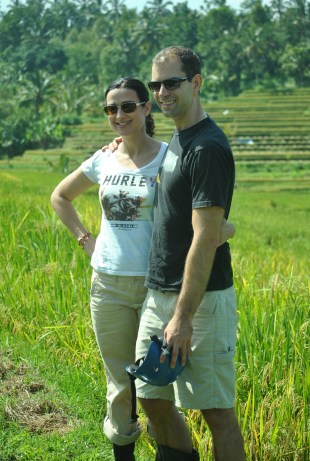
How to write a sequel

Maker:L,Date:2017-9-28,Ver:5,Lens:Kan03,Act:Kan02,E-Y

I originally posted this while writing the follow up to One Summer in Santorini. It is 14 months on, and I have edited this post accordingly.

I begin this post by planting my tongue firmly in my cheek. I would love to say that I’ve unlocked the secret, that I’ve discovered the Holy Grail of writing, that I’ve figured it out! In truth, I have discovered a kind of secret sauce for myself. Other writers may benefit from my ‘process’, so if anything I say resonates, have it – it’s yours.

Reflect on book one

I wrote book one, One Summer in Santorini, for several reasons:

  • My previous agent told me that the book I was writing at the time was my 5th book, not my 1st – too many characters and a multi-narrative. “You’re not Liane Moriarty,” he said. “Yet,” he added. He then challenged me to write a simple, linear narrative. Which I did.
  • It was a love letter to my partner, Ben. We met in Greece and I borrowed (rather heavily) from our story for the book  – the first half anyway. When I introduced a love triangle I was well into the realm of fiction.
  • It was a love letter to Greece. Greece is a place where you go to fall back in love with yourself – and with being alive. It challenges you to participate in your own life. If you haven’t been, go.
  • I had some demons to exorcise. I was single for half my twenties and most of my thirties. And by ‘single’ I mean I dated awful men who I changed or hid myself to be with. I wanted to write about a woman who calls an end to that, who won’t compromise herself again to be with someone.

Make time

I wrote book one on weekends and on evenings after working at a full-time job where I spent the bulk of my time writing. It was often hard to come home (usually post gym or errands) and sit down and write for myself. I did it, but it took a couple of years.

For the sequel, I had time. In 2018, we were on a year-long sabbatical. I had contract work, but I could dedicate significant chunks of time to writing. I started writing the sequel in February while we were still in Australia and I hit 10,000 words. I was reasonably happy with that progress, but my goal in Bali was to up the pace. After 8 weeks there, I finished the book at about 95000 words.

Celebrate the milestones

Every writer gets to decide what each milestone is. I celebrated when I got through an emotional part (if the writing left me sobbing or laughing out loud – milestone!), or I finished a chapter. The sequel is written in parts – and finishing each one was a milestone. Celebrating, by the way, included sharing on social media, pedicures, cocktails, massages, and congratulatory hugs from Ben.

The secret sauce

With book one, I had to knuckle down. I had to carve out time, and often had to force myself to sit down and write or edit or proofread. I had to self-impose deadlines and get others to hold me to account.

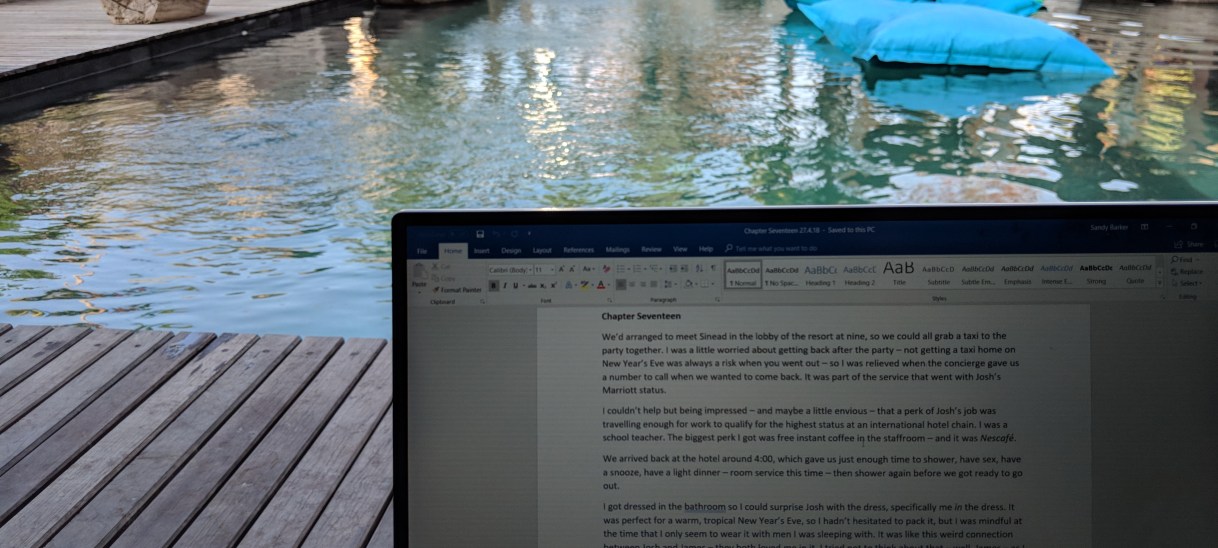
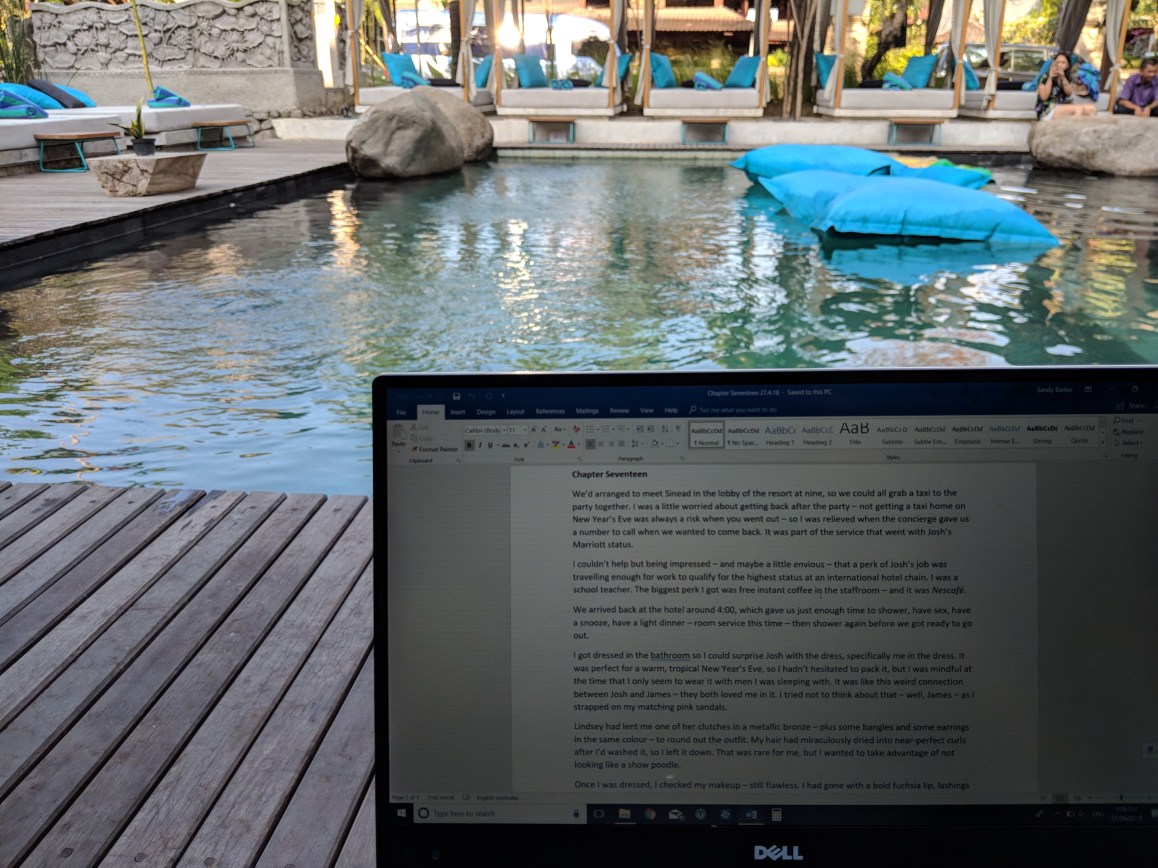
Being in Bali, with the luxury of time, the portability of a laptop, and being inspired by my surroundings, I had an absolute ball writing the sequel. And I worked faster, which meant there was continuity in the writing – the style, the voice, the narrative, character development. I had to work laboriously at that in the editing process of One Summer in Santorini, because I wrote it over such a long period of time. With the sequel, I’ve made the editing process easier on myself, just by writing over such a concentrated amount of time.

Most importantly, though, I let the story come to me.

This is the hardest part to explain, and is still my process. I start with only a rough outline, and I have no idea how many chapters it will take to tell the story. For the sequel, I didn’t even know how it ended when I started writing it.

When I got stuck, or I didn’t know what would come, I stepped away – sometimes for a few hours, sometimes days, and when I was doing something else – running, cooking, dodging scooters on the road – it came, the next part of the story. Then I would sit and write.

I’m so grateful that we made this decision to pack up our lives, sell up our stuff, leave our jobs and to live around the world. It was my special not-so-secret-anymore sauce.

While on sabbatical, I also wrote another follow up to One Summer in Santorini about Sarah’s sister, Cat. This book will be out early next year with the sequel to follow.

Don’t (not) look down: walking in Bali

We’ve been living in Ubud for 7 weeks now (one week to go before we move to the US). We opted not to get a scooter for the duration of our stay and walking most places has been transport, sight-seeing and exercise. For longer journeys, we’ve grabbed taxis, but according to my FitBit, we’ve clocked up hundreds of thousands of steps in the last two months.

The trickiest thing, though, is that walking here is a precarious endeavour. Obstacles include:

  • no footpath – you’re essentially walking on the road a lot of the time
  • stray dogs and dog excrement – even the dogs with owners wander here
  • offerings to the gods – to be respectful, we must avoid stepping on these
  • scooters and motorcycles – MANY of them, both driving and parked
  • giant tour buses, trucks, cars, and taxis – all driving within inches of you as you make your way down the road that doesn’t have a footpath – eeek!
  • broken footpaths – giant holes, missing tiles, broken bricks, and cracked pavement
  • streams of unidentifiable water – hopefully it is just water, but you never know 😉
  • stalls and shops that spill out onto the street
  • rooster in baskets – they’re fighting roosters 😦 – and random roaming chickens
  • giant piles of dirt/gravel/bricks used for building – when people are building a home or business or even a wall, often the materials will be dumped by the truckload on the road and footpath – everyone just has to go around it until it’s all used up
  • random debris/detritus/rubbish
  • uneven, patch-work paths – including the (running) track along Campuhan Ridge and the pedestrian-only paths

So, here’s my photo series called: Don’t (not) look down!


Bali: what to bring, what to buy here

MVIMG_20180403_100437.jpg

When we decided to spend two months in Bali as the first leg in our year-long sabbatical, I read as much as I could find about what to bring and what to buy when I got to Bali. The information was scarce, scattered and often dated. Hmmm.

I did my best, but over-packed some items which are abundant and ‘cheap as chips’ in Bali, and didn’t bring enough of some others.

Here are my suggestions for long-term visits to Bali.

Bring

  • sunscreen We did well here. We each brought a two-month supply of aerosols, pump-packs and tubes of sunscreen. It is extremely expensive in Bali (it starts at around 200000R or $20AUD per bottle).
  • liquor We bought liquor duty free and were allowed to bring in 1L each. Mixers are cheap here, so it is an inexpensive way to have a drink at your accommodation.
  • salon hair products I didn’t bring enough. And my hair is paying the price. Pantene and other supermarket hair products – shampoo, conditioner, styling – which are full of sulfates, silicon and other hair no-nos are readily available and are cheap. The good stuff is hard to find, and is comparably expensive.
  • vitamins and supplements These are (pretty much) cost-prohibitive in Bali. They are 2-4 times the price in Australia, and 4-6 times the price in the US/UK/Canada, etc. We ran out of zinc and it was 4 times the price as in Australia.
  • ziplock bags We brought a stash of these in different sizes and have used them – a lot. They’re great for using your Kindle on the beach or next to the pool and for keeping snack foods fresh. They don’t weigh a lot and they pack small.
  • re-usable water bottles We brought our own. Many places, including accommodations, restaurants, and gyms, have bottled water coolers or provide filtered water so you can top up your water bottle. Bottled water is readily available, but recycling in Bali is not as prolific or as effective as it is in other places. If you can avoid buying small plastic bottles of water, please do.
  • Mid- to high-end skin care It will be hard to find these products – I haven’t seen them – so I recommend bringing your own.

Buy here

Things that are very cheap – or quite a lot cheaper – in Bali and that you will be able to find in the nearest supermarket:

  • ‘drug-store’ (US/CA), ‘Priceline’ (AU) or ‘Boots’ (UK) skincare products If it is an inexpensive range of skincare at home, you can buy it here – and often much cheaper than at home.
  • toothpaste/mouthwash
  • deodorant
  • shaving cream A little cheaper than home and readily available
  • bug spray Cheaper than at home and readily available
  • body/hand moisturiser
  • body wash
  • micellar water (makeup remover) It’s much cheaper than at home
  • tissues/wipes/cotton pads/buds
  • nail polish remover Also, professional mani/pedis are inexpensive here
  • tampons/pads
  • Yakult It is a LOT cheaper than acidophilus tablets and is readily available – it’s a great way to keep your gut healthy – and a lot cheaper here than in Western countries
  • coffee beans If you’re a coffee fiend and travel with your own grinder/press, the coffee beans grown and roasted in Bali are very good and around the same price as home.
  • beer Not that you’d bring a two-month supply of beer, but Bintang (Bali’s national brand) is drinkable beer and is super cheap, and you can get San Miguel (and SM Light – low calorie, full alcohol), which is a lot like Corona and is also cheap here.
  • snacks You’ll be spoiled for choice (see the pic)
  • hats sunhats are cheap here and readily available. They’re also hard to pack without squashing them, so just buy them here.

Buy ‘in a pinch’

  • electrical adapters These are much cheaper than at home if you forget yours, but may not work as expected – or at all.
  • Nuts/granola/protein powder/protein bars These are expensive here or may not be available, so if they are very important to you and your daily routine – and you have the weight in your luggage – bring them instead of buying them.
  • Clothes for sun-cover I needed a high-neck T-shirt for sun-cover, and it took me 2 hours to find what I needed, after going in and out of around 15 shops. The sun is intense here. Bring clothes that cover you when you’re out and about; buying them here is a little time-consuming and you will pay close to what you pay at home.
  • Swimsuits Ben lost his in a taxi after a group trip to the beach. The usual surf brands have stores here and you can spend $80+ AUD on a swimsuit (for men or women). We managed to find one on sale for $30 AUD.

Live without it

  • Wine The taxes imposed on imported wine make it 3-5 times the cost of what you’d pay back home. They do make wine here, Two Islands, which is made from South Australian grapes and is okay but pricey for what it is, and Balinese wine, which is made from grapes they grow here and harvest 3 times a year. It’s not cheap for what it is, and not really drinkable. I recommend that you just don’t bother drinking wine.

The new normal

When you’re living abroad, there are things that were initially obvious to you – or even jarring – that over time become your new normal.

Here are some from living in Bali over the past couple of weeks.

Where there’s a wool…

I have turned into a sheep. I have naturally curly hair; it’s fine and I have a lot of it. In Bali, where the humidity creeps down to 80% but typically sits in the 90s, my hair has turned into what I can only describe as ‘wool’. I can slick it back, pin it back, put a shot-glass full of product on it, and half-way through the day, I look like a sheep. Yesterday, I decided not to fight it. I loaded up the hair product and let it dry naturally. The result: thick spiral curls. I was okay with the curls until I went for a massage and she massaged my head. Goodbye curls, hello wool. When I sat up I looked like Shirley Temple after she’d been electrocuted. It’s my new normal.

Baaaaaaa.

MVIMG_20180327_141924.jpg

That’s rubbish

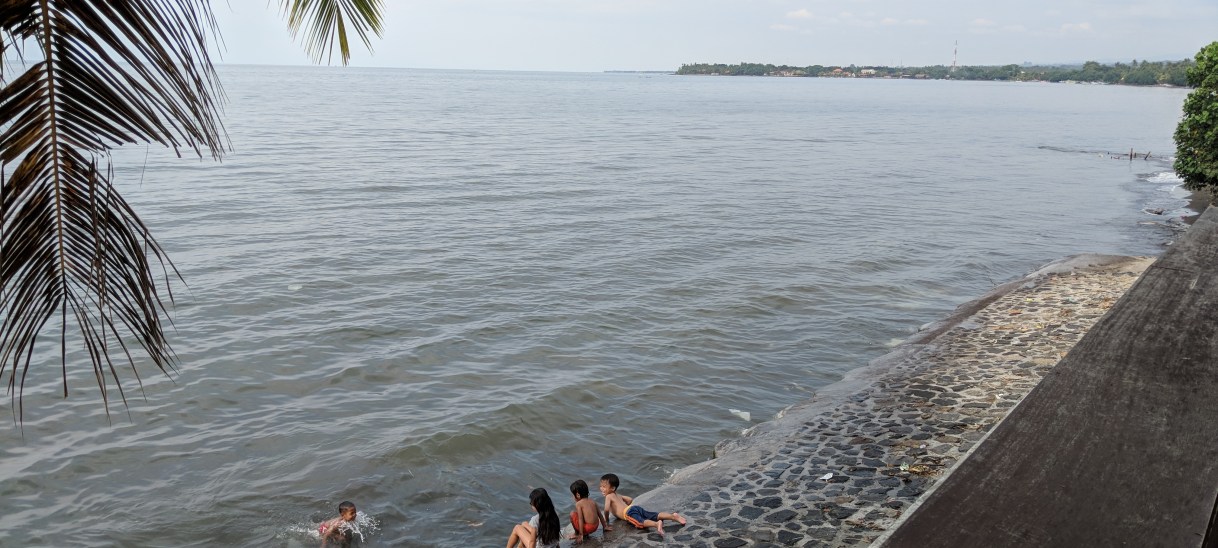
Quite simply, in Bali, there is garbage nearly everywhere. While visiting friends on the north coast over the weekend, we were admiring the water views and watched a local woman simply sweep a pile of garbage – mostly plastic – into the ocean. In fact, there is so much garbage in the water off Singaraja and Lovina Beach, no one but the locals swim there. Every dot in the water in this photo is a piece of plastic and there are hundreds of pieces in amongst the rocks. It’s sad to see in this otherwise idyllic scene.

Maker:L,Date:2017-9-28,Ver:5,Lens:Kan03,Act:Kan02,E-Y

And here are some local kids playing amongst the detritus, oblivious.

Maker:L,Date:2017-9-28,Ver:5,Lens:Kan03,Act:Kan02,E-Y

Kamikaze drivers

Apparently, the speed limit across most of Bali is 40km/hr. From our road experiences to date, there will often be long stretches of driving where we won’t crack 20 and then suddenly, we’ll be flying down the road on the wrong side doing 80 and overtaking a scooter piled high with reeds or baskets.

There seem to be no road rules, and even a red light is merely a suggestion. Overtaking is the only way to get anywhere and there are no roads with more than one lane in either direction. On many occasions, I’ve had to place a lot of trust in the driver that they don’t want to die either, and that we will not have a head-on collision with that huge bus coming straight at us. My new normal is to take these journeys in stride (Valium sold separately).

Maker:L,Date:2017-9-28,Ver:5,Lens:Kan03,Act:Kan02,E-Y

I’ve also stopped being baffled by the westerners who wear helmets while riding a scooter, and strap their helmet-less baby to their front, or let their helmet-less toddler ride standing up between their arms. No, your parental powers will not prevent your child from getting a serious head injury if you have a collision.

Taxi!

The last time I was in Bali in 2015 and the time before that in 2003, the cry from vendors as you walked down the street was, ‘You buy? You buy?’ In 2018, I have yet to hear ‘You buy?’, but even a short walk will elicit cries of ‘Taxi?’ from all directions. Men – I have yet to hear this from a woman – watch for tourists who look lost, hot or tired – or all three –  and ask if they want a taxi ride.  They will then ‘phone a friend’ who shows up in a car to whisk you away to wherever you want to go.

Taxis here are reasonably cheap, most are newer model cars, and as the Balinese take pride in their vehicles, they are immaculate. That said, we’re more than happy to walk – especially when it’s for exercise – so our new normal is to say, ‘no thank you’ a dozen times any time we decide to walk somewhere.

(Not) wining and dining

Wine is expensive in Bali – even the bad stuff, like Yellow Tail. Sorry, Yellow Tail, but even though I miss wine, I will not pay $30 Australian for you. There are some Balinese wines, but as they pick 3 vintages a year here, the grapes – and the wine – are apparently flavourless. Our new normal is to drink Bintang beer (that is, Ben drinks Bintang) and spirits. Spirits are not cost prohibitive, and it’s nice to have a gin and tonic with fresh lime (Mmm, lime) as a sun-downer. I am, howeverlooking forward to our stint in Seattle in May when we can hit some of our fave Washington wineries!

Bintang_Beer_by_the_Beach

Also, my new normal is co-living, but that’s another blog post…

Living La Vida Local

Part of being a digital nomad, rather than being on a year-long vacation, is actually living in the places we are visiting.

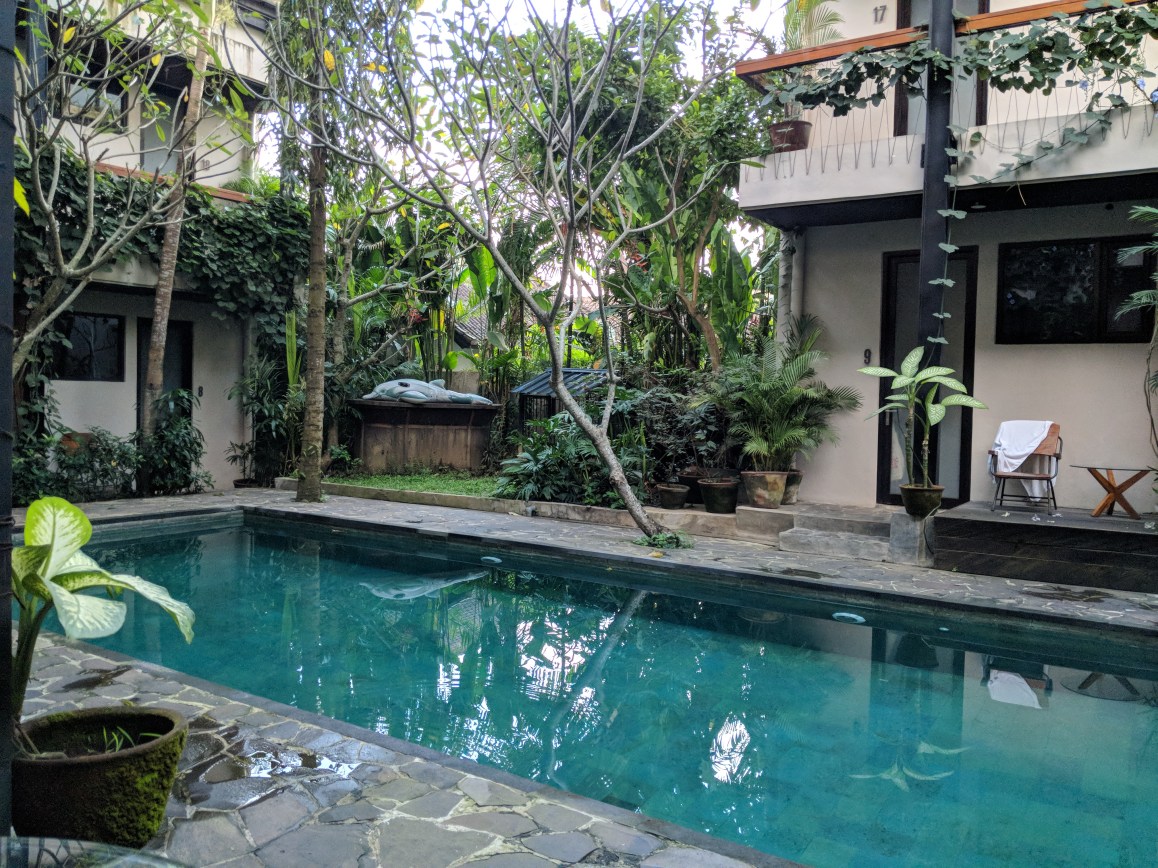
We are currently based in Ubud, Bali, staying at ROAM, a co-living space where we have our own room and bathroom and share all living and working spaces with other digital nomads.

When people ask us where we live, we say, “For now, we live here.”

ROAM is about 2kms from central Ubud and the pace here is both peaceful and frantic, depending on what we’re doing and where exactly we are. Last week, on day one, we made the 15 minute walk to the supermarket to stock up our pantry and fridge. Most of the walk looked like this:

And the last part looked more like this:

Ubud3

Both have their merits – the scenery and many of the Balinese structures are just beautiful – and we are becoming very agile having to side-step precarious footpath hazards, stray dogs, scooters, and chickens as we make our way around the town and its surrounds.

The trip to the supermarket was fantastic. Yes, it is a large store with a good selection, but I am one of those people who finds it fascinating to trawl around a supermarket in a new place, particularly a new country. We spent well over an hour walking the aisles figuring out how to feed ourselves up to three meals a day in a (reasonably) healthy, affordable, somewhat local way.

Living here also means working here.

And this year, ‘work’ means both writing (like this blog post) and working for clients. I am currently mid-project for a US-based client, which will wrap up by the end of the week. Then I will return to writing Book 2 of the Someone series – Chapter 5 awaits!

There are quite a few options for working at ROAM, as the robust WiFi is accessible everywhere. There is an undercover rooftop work space, but for editing work I prefer the quiet and coolness of the little conference room tucked at the back of the property. (Ben likes it too.)

ROAM1.jpg

It’s still early days yet for me to figure out my favourite place for writing. Perhaps on our little front porch, on a sun lounger by the pool, in the little conference room, or maybe on the rooftop with the other digital nomads.

Living here also means getting out to see what there is to see.

We started today with a stunning walk along the Campuchan Ridge with two of our fellow Roamies, Yuliana from Ukraine and Nana from Denmark. The walk rises away from a riverside temple and meanders along a ridge with views on either side.

Maker:L,Date:2017-9-28,Ver:5,Lens:Kan03,Act:Kan02,E-Y

It leads to a little village where there are several resorts and even a little coffee shop, where the coffee was excellent – and cheap!

Living here also means the day-to-day stuff of life, like doing laundry and cooking meals.

But it also means that I can have my morning cup of tea and read my emails with this aspect on our little porch.

ROAM4.jpg

We have plans to keep getting out and about – both here in Ubud and further afield in Bali – so we can soak up as much of Bali life as possible. But for now, I feel right at home, and am loving living la vida local.


Wherever I lay my head…

The expression, ‘wherever I lay my hat, that’s my home’ has never been as relevant for me as it is now. As I only wear a hat on occasion, however, I think of it more in terms of wherever I lay my head.

Since we handed over the keys to our apartment on Feb 2nd, Ben and I have been on the go – first to New Zealand and currently in Western Australia where we’ve been visiting family and friends. We have stayed in 13 different places in the last 6 weeks, and in each one we’ve found a way to think of it as home – even if it’s only been for a night.

Nesting

I am a nester. I am being told by spellcheck that ‘nester’ is not a word, but I have been a nester for as long as I can remember so I will respectfully disagree, spellcheck, thank you very much.

As a nester, I will always unpack certain things from my luggage even if we’re only there overnight. These things help the location to feel like home. I plug in my electronics, I unpack my toiletries, I pop something familiar on my bedside table. Instant ‘home’.

Drawers

If we’re somewhere for a few nights or more, my nesting goes to a whole new level. I put things in drawers! Imagine that!!

I am especially looking forward to Bali (our next stop) because we will be in one location long enough to unpack completely and put our luggage away. Since Feb 2nd, we’ve been travelling with packing cubes. They are excellent for keeping things organised and mean that I don’t have to go rifling through my whole suitcase every time I look for something –  they’re kind of like drawers for your luggage.

But this morning, after the seventieth time one of us opened or closed a zip, I realised that I was done with the sound of zippers for now. Drawers! I am ready for actual drawers.

Tahoe and Squirt

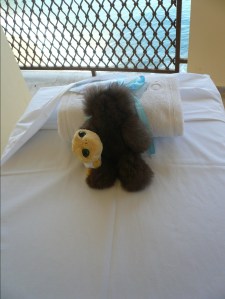
We’ve been travelling with Tahoe (he’s the bear) and Squirt (he’s the turtle) for over a decade. They’ve been everywhere we’ve been. Even when we’ve travelled alone (for work or play), Tahoe and Squirt have gone along. They’ve been to places I’ve never been, like Ireland and Argentina. Having them with us makes wherever we are feel like home – and they’re very adventurous travel companions.

P1040241
Ready for a massage in Mexico
P1000760
Looking out the window in Vietnam
P1020199
Twin beds in Italy

Ben

Ben and I have lived together since December 2008 in four apartments in two cities. No matter where we are in the world, he is now my strongest connection to feeling like I’m home. He is my home.

So, until 2019, until we sign a new lease and get a set of keys again, wherever Ben lays his head, that’s my home.

P1010920
Bali 2015


To Airbnb, or not to Airbnb…

Before Ben and I officially start our year’s sabbatical in a couple of days, we have taken a quick side trip to New Zealand, a place we have now been to four times together, and which holds a special place in our hearts.

Seven out of eight nights have been booked in Airbnbs, and here’s why we love them.

1. You get to meet interesting people

Every stay is a chance to meet someone new – sometimes a single, sometimes a couple, and even families. Last night we stayed just out of Dunedin with a father and son and their three pets. Sophie the dog made the stay especially fun; from the moment we arrived she decided we were her new best friends.

A couple of nights before we stayed with a lovely young couple who run a farm. Not only did we get to meet their pet goats and sheep – Scott can’t bear to slaughter them, so they get treated to chocolate chip cookies instead – but we had a lovely, unplanned meal with Scott and his partner. They had offered us free rein of their garden, and after harvesting a feast of fresh veggies, I sauteed them in olive oil. Delicious. Because it was a farm stay, we also had fresh eggs, bacon and homemade bread for brekkie. Divine.

2. You get to stay in places you may not be able to afford otherwise

Queenstown is up there among my favourite spots in the world for scenery, but accommodation can be very expensive. Airbnb makes it affordable. We stayed with (another) lovely couple in the studio apartment above their house. The views were phenomenal and our hosts had thought of pretty much everything we might need.

3. You get off the beaten track

Often, this is because you’re staying just out of town, somewhere you otherwise wouldn’t have seen, but it’s also because staying with locals can give you an insight into the area that the brochures can’t. Locals will be able to tell you the best places to get something to eat – often away from the crowds and with a local flare – the secret trails down to the water, the best places to see the sunset, or where to get a good local wine that’s not available in shops.

P1020091
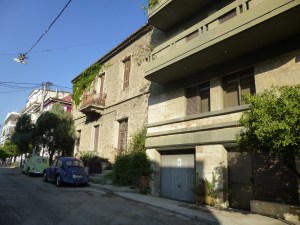
Our neighbourhood in Athens 2016

4. The unexpected and very pleasant surprises

Between us, we’ve stayed in Airbnbs in the US and Australia, as well as Athens, Barcelona, Bath, New Zealand, Tuscany (in a castle!), Cape Town and Amsterdam. We’ve had a lot of wonderful, unexpected experiences because we opted for Airbnb rather than a hotel.

When we stayed in Napa Valley in 2014, it turned out that our host was a private chef. He invited us to join a degustation dinner he was cooking for friends the first night we were staying – and his friends were all Napa wine makers. The meal, the wine, and the company were all amazing – and we were invited to attend a vintage release party the next day as special guests.

While travelling with my 5-year-old nephew and his parents in 2016, we arrived at a 700 year old castle in the town of Montespertoli (Tuscany) several hours late. For some reason, we hadn’t anticipated that collecting a pre-paid rental a car would take 3 hours. Our hostess took pity on us, weary, hungry travellers, as we had arrived in town between mealtimes and there was nowhere for us to get something to eat. She disappeared into a kitchen and came back with fresh bread, an array of cheeses, and sliced apple, and then poured us a selection of the castle’s wines to taste. The 5-year-old wasn’t the only one who was grateful (just cheese, bread and apple for him).

P1020200
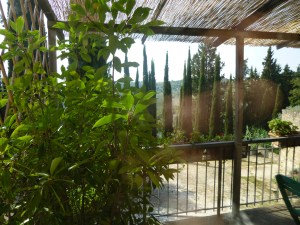
View from a Tuscan balcony

These sorts of special experiences don’t happen to us when we stay at hotels. Yes, we have had one or two odd, or not-so-awesome, experiences staying at Airbnbs, but on the whole, we prefer them to more traditional accommodation choices. More often than not, we’re delighted with our stays.


Take, Chuck or Store?

Over the past few weeks and months, Ben and I have been playing our own version of Shoot, Shag or Marry – only with our stuff. We have literally handled and considered every item we own and have asked ourselves, ‘take, chuck or store?’ That’s every darned thing.

When we originally talked about taking this sabbatical, we discussed options at two extremes of the continuum: either get rid of everything and start from scratch when (if) we return, or sublet our apartment fully-furnished.

We opted for something in the middle. We rented a 2m x 3m storage unit for a year, set a moving date and started playing our ‘fun’ new game.

Take

I am proud to say that I have pared back to 5 pairs of shoes – and that includes thongs (flip flops). Those who know me will understand the extent of this miracle. Let’s just say, I have just a touch of Carrie Bradshaw in me. So, what made the cut? Thongs, sneakers, trainers, Birkenstocks, and ballet flats.

I also packed a small pouch with what I call, ‘very useful things‘. These include a small chef’s knife, a stash of zip and twist ties, command hooks (with two-sided tape), a sewing kit, Blue-tac, a portable clothes line, and carabiners. As, I said, very useful things.

Add to the shoes and very useful things, Summer clothes, a collapsible backpack, my stack of technological rectangles (laptop, iPad, Kindle, phone) and chargers, enough underwear for a month, a small stash of my fave (but not expensive) jewelry, and toiletries, and I am good to go!

Chuck

While going through all the things we own, we made the easy decision to off-load the bedside lamps that I’ve never really liked, and the more difficult decision to sell our couch, which was cherry red and made to order. I loved that couch, but am pleased to say it went to a good home.

IMG_20180106_152150
Much-loved couch

In the end, we sold off, gave away, donated and binned about 1/2 of what we owned.

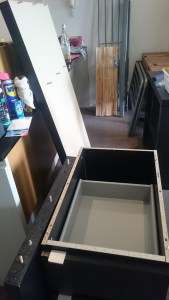
Hard rubbish inherited an array of things including my desk, which broke into three pieces when we tried to move it, our well-used and somewhat abused BBQ, our bedside tables which were on their last legs, and every chipped or mismatched cup, plate, bowl, glass and teapot.

DSC_0829
Discombobulated IKEA desk

We even managed to eat through the bulk of our pantry, fridge and freezer in the weeks leading up to the move, which resulted in weird meals, like Dim Sum with Greek salad. The rest was bagged up and taken to our friend’s house to fill (clog) up their pantry and freezer – thanks (sorry), guys!

DSC_0827
Who else has 3 open packets of sesame seeds in their pantry?

Store

Deciding what to put into storage – or rather, what we would pay to store – was perhaps the hardest set of decisions, but we quickly discovered what I will call, ‘the second drawer factor’.

Every kitchen has a second drawer, the drawer filled with random, often costly, utensils and useful kitchen things. Some are used daily, some rarely, but when you’re paying for storage, setting aside 1/3 of a small box for these items is a lot cheaper than replacing them when you next set up house. I’m talking about you, ice-cream scoop, pizza cutter and citrus reamer. The same goes for other small, useful household items and tools. They essentially cost next to nothing to store and a lot to replace all at once.

Clothes were a little trickier. I kept quite a few of my work clothes, mostly because I tend to buy items that don’t date and that I look after. They’ll be great for those 2019 job interviews. We also sent a box of Winter clothes, coats and boots to the UK for the last 1/3 of our trip which will be in cooler or cold weather.

Art, artifacts and memorabilia were a no-brainer. When we travel, we buy souvenirs – paintings, photographs, ceramics, books and such. We also each have a collection of childhood memorabilia. These things will make our new home feel like ours.

Anything else we had room for: When I commenced packing, I started with books. Books are easy to pack; they have uniformity and you can stack them. I was really proud of my first few boxes – so neat, so organised, so easy to label: ‘books’.

By the time I finished packing, my labels read like this: ‘iron/hair diffuser/decorative rock/greeting cards/board game/lamp/place-mats’. It became less about ‘like things together’ and more like a real-life game of packing Tetris. In the end, we had the room, so I started to be less stringent with the culling. If we liked it and if it still worked, it got packed.

DSC_0835
Final trip to storage after living in a near-empty apartment for a few days

The (real) lesson

When you start to sort through your stuff, and when you do a complete audit of everything you own, you tend to realise that we exist everyday with far too much stuff. We are each about to travel for a year with only a suitcase, a carry-on and backpack or handbag. No doubt, we will continue to do some ‘chucking’ along the way.


Why I’m taking a mid-career sabbatical

DSC_0036
Outskirts of Ubud, Bali 2015

“Let’s trade a year of our retirement for 2018,” said Ben. We’d been toying with the idea for years, but he was giving it a time-frame, making it concrete. Initially, my stomach clenched at the thought, but I took a deep breath and said yes.

Ben and I have long described ourselves as ‘location-agnostic’, but in the truest sense of that term, we won’t really be location-agnostic until 2018. Up until now, it has meant that with no children and no mortgage, our lives are relatively portable. Yes, we will always have the hoops of immigration laws to jump through – he is American and I’m an Australian with a soon-to-be-much-less-useful British passport – but we have already lived together on two continents, and next year we’ll add two more.

What is the plan? In 2018, we will travel to several destinations where we will stay for 1-3 months, unpack, live like locals as much as possible, and essentially be location-agnostic. First stop, mother nature permitting, is Bali. We will be staying at ROAM, a co-living space designed for digital nomads – another moniker we’ll be trying on for size.

After a couple of months in Bali (a once-renewed visitor’s visa gives us a maximum of 60 days in Indonesia), we will head to the US and Canada. I get 90 days in the US, including any hops out and back in to Mexico or Canada, so we will spend a few weeks visiting family and friends, and then a significant amount of time living by the lake at the family’s cabin. After the US is England, with travel to Scotland, Wales, and Ireland. And we’ll likely finish out the year with a few months in Portugal, or somewhere equally beautiful and affordable in Europe.

What will we be doing? We both have some contract work lined up, mine in writing and editing, and Ben’s in mobile app development, but the aim is to make time each day and week to immerse ourselves in our surroundings, to go, see, do and experience. Importantly, I will write for myself – first the sequel to the novel I just published and then other ideas that have been percolating for (it seems like) eons. And of course, there are the people – people we know and love who are scattered all over the world, and the people we haven’t met yet, ex-pats like us, friends of friends, locals. We’ll take photos and write, and share our year. We’ll embrace opportunities as they arise, promising ourselves to say yes more than we say no.

Why are we doing this? The simplest response – which is both contemplative and realistic – is that ‘life is short’. The more complex response involves the label we have long self-identified with. Will we actually want to live a location-agnostic life long-term? Are we going to retire in 10 years, sell off our possessions, and flit about the world being ‘homeless’? Can ‘home’ really be wherever we lay our respective hats and/or suitcases?

We will see.

How are we preparing? With lots of research, lists, and spreadsheets. Between us, we are figuring out what to store and what to sell, what phones we will use, what insurance we should buy, how we can maximise our collective frequent flier points on 6 airlines and across 4 continents, who is prepared to put up with us for a night or 3 or 8, and other fun logistics. We’ll be frugal when we can, so we can go, see, do, and experience as much as possible. We’re teeing up contract work, and making professional connections. We’re buying lightweight travel versions of things. We’re only packing clothes that go with everything else we’re packing. We’re shipping winter clothes and boots to England. We’re busy!

What do we hope for? I will only speak for myself here. I am hoping that time will start to slow, that the creative juices will flow, that I will take (better) care of myself, that I will relish the time with Ben and other loved ones, that I will embark on new friendships, that I will embrace challenges and adventures, and that I will get less attached to things and routines.

And in 2019? Again, we’ll see…


Where the winds take you

A year ago, Ben and I were about to embark on a journey back to the Greek Islands, revisiting some of the places we discovered together in 2006 – when we met.

Our skipper from the sailing trip in ’06, Patrick, would be at the helm again. We’d get to see new places, we’d make new friends, and we’d celebrate a decade since we first met on the pier in Santorini.

This is about where the winds take you…

There’s something rather magical about going where the wind takes you, quite literally. The cares and stresses of everyday life ebb away, and the present becomes everything. Briny air, inky blue swells, and a wind that carries you and your fellow sailors to the next port. It’s freeing.

Seven people, one yacht, five Greek islands and one incredible week.
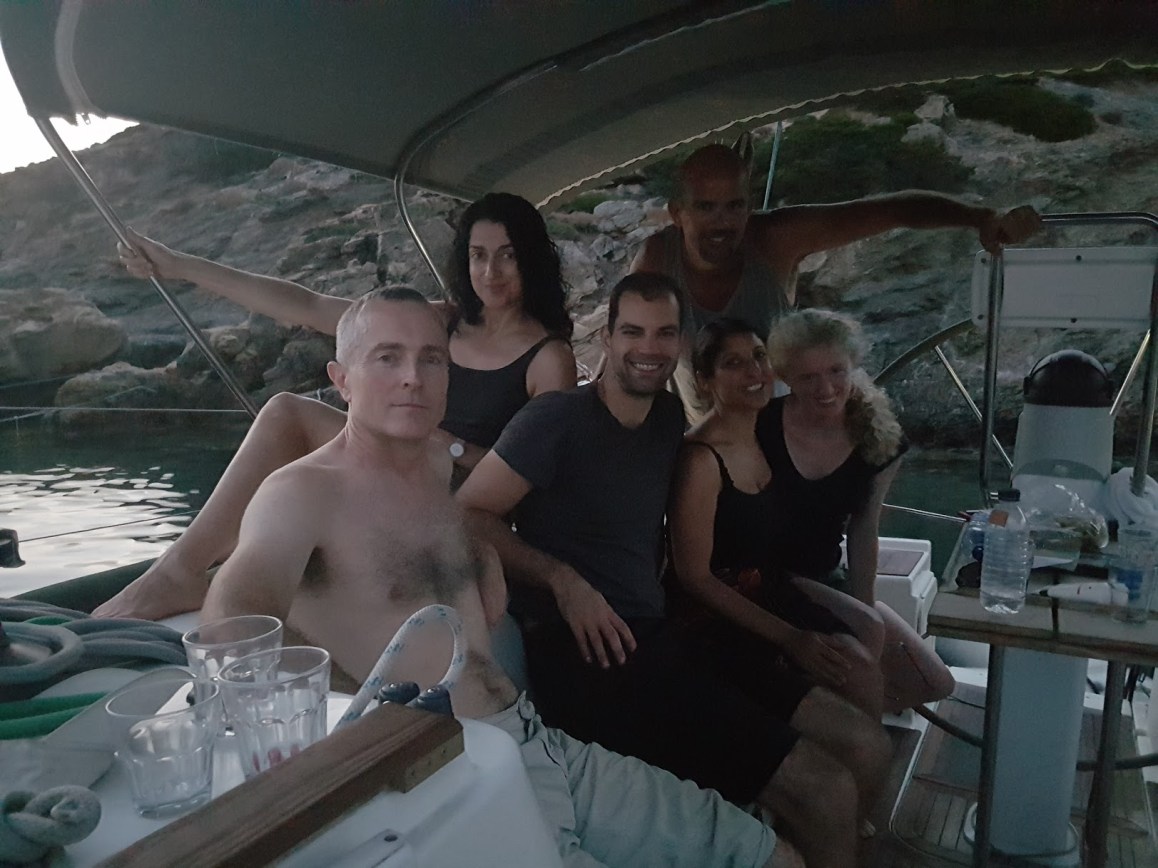
Group pic - sailing trip

Day One

We meet with eager faces at the port of Vlychada on the southern coast of Santorini. The marina is abuzz with energy as dozens of people chatter loudly and mill about between the dock and their vessels, a mixture of pleasure craft and fishing boats. The weather is a perfect 28°C with a warm breeze and only a few clouds in the vibrant blue sky.

Our Skipper, Patrick, shows us to our boat, the Argo, and we take turns to climb aboard and explore below deck, unpacking what we can into cubbies and stowing our luggage. The Argo will be our home for the next week. I take off my watch and stash it away, because I won’t need it today. Time moves differently when you’re on a boat.
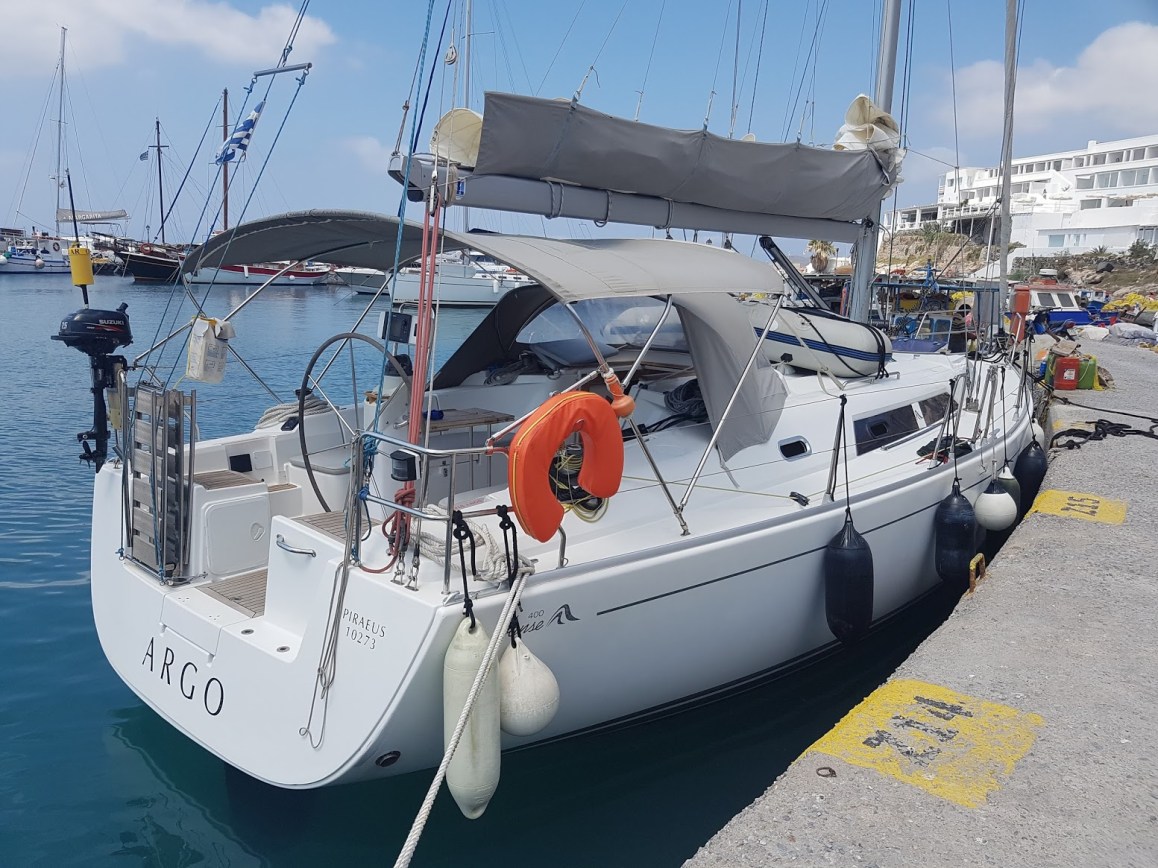
Our boat

We are seven, including Patrick, our ages ranging from mid-30s to mid-50s. We are across industries and continents in our everyday lives, but for the next week we will be the Argonauts, as dubbed by our Irish boatmate almost as soon as she is aboard. Both her laugh and instant camaraderie are infectious.

Tonight, we will anchor just off Akrotiri on Santorini, as the winds will be more favourable for our sail up to Ios in the morning. None of us mind. The view is beautiful and we enjoy swimming off the boat in the deep Oxford blue water. Colours, particularly of the water, will be important to the Argonauts, because every day we sail, the Aegean will reveal its vast palette and we will discover that the waters off each island are distinctive.

We watch the sunset over the island, and then break into two groups for a short ride to shore on the tender. I’m in the first group and we pull up at a restaurant where the tables are surrounded by water on three sides. A tall waiter sees us coming and hurries to help us ashore, a task that sounds simpler than it was, with the water line 3-feet below him. Patrick returns to the Argo while four of us get settled and devour the menu with our eyes.

When the others join us, we order practically one of everything and chat amiably over fresh seafood, deep red and delicious tomatoes, and tangy dips with crusty bread. We drink table wine, which is surprisingly drinkable. We don’t finish everything on the table, but we are full and when the sun completely disappears, we make our way back to the Argo. It takes only a few minutes to get used to the gentle rocking as we drift asleep.


Day Two

Sailing through the caldera offers a magnificent view not just of Santorini, but also of Thirasia, the island sitting opposite, and the ever-evolving Palea Kameni which is situated in the caldera’s centre and was site to the cluster’s most recent eruption in 1950. Looking up at Fira and the other towns that cling to the rock faces, you can’t help wondering how they stay there and what feats of engineering got them built in the first place. It’s stunning.

We moor for lunch in a cove just off Thirasia with a perfect view of Oia, the town perched on Santorini’s northernmost point. The water here is cooler than off Akrotiri, but after a simple lunch of tomatoes, bread, tzatziki and cheese, we swim off the boat until we’re called back aboard by our Skipper. For the first time, we will be solely under sail as we begin our trip north to Ios.

Patrick gives orders to his crew of civilians with the ease of someone who has done this many, many times before. With his guidance and good humour we make ourselves useful, raising the sails and setting course for the port of Ios. Once underway, he directs several of us to sit on the windward side of the boat. It will make us sail faster and is also a better spot for those of us with seasickness. Some of us – me included – do not have our sea legs yet.

The undulating sea is mesmerising and the seasickness does recede as we talk about nothing and everything. We will find that we form friendships quickly with so much concentrated time to get to know each other. Every once in a while, as we change tack, there is a burst of energy as we’re all given something important to do.

Ios emerges in front of us through a low haze, and before long we can make out the brilliant white of a church standing guard at the entrance of the port. As we get closer to our destination, we erupt into action as we make ready to dock. The port is crowded, but we ease into a berth between a luxury yacht and another sailboat, its Italian skipper lending a helpful hand as we secure our moorings. I am fascinated by the easy camaraderie of the two skippers despite being strangers and not speaking each other’s language.

Docked in Ios

Ios is bustling. It reminds me of Fira, only the crowd here seems to be mostly of twenty-somethings. We’re here for dinner, then to sleep the night and we will be off after breakfast. In the interim, we must shop for the following four meals, and will be on water rations until we reach another serviced port in two nights’ time. Patrick’s promise of a spectacular and secluded spot to spend our third night has us intrigued.

Dinner that night is close to where we have docked – we can see the Argo from our seats – and we order cheap, traditional food. Once again we don’t clear our plates, because it is so plentiful. Ios is alive. Children play loudly nearby as we eat, adults laugh and toast each other, and there is a thrum of energy. At a time when I would typically be asleep, it seems like Ios is just getting started. After dinner, we seek out the ice cream parlour and wait in a long, but fast-moving line. The ice cream is excellent and more reminiscent of gelato.

I wonder at being able to sleep aboard a boat docked in such a busy marina, but lull of the rocking sends me off peacefully.

Day Three

The supermarket is busy, extremely busy. The narrow aisles are crowded with goods and tourists. We have a long list and four of us are navigating with two trolleys. We need four meals, snacks, bottled water and drinks – wine and beer. One of us knows a bit about Greek wine and is scouring the wine aisle for some good picks. We check out having spent far less than we’re all used to spending in our respective home countries, and the frenzy of the market will prove a vast contrast to the second half of our day.

We are heading towards a secluded bay on the island of Dhespotiko, a spot Patrick found on his last trip. The sail is shorter than yesterday’s and I find that I am acclimating to the rhythms of the Aegean and finding my sea legs.

As promised, the hidden bay is incredibly beautiful. The island rises sharply from the water on either side of the narrow bay and is covered in reddish rocks and tufts of green. We anchor just off a small sandy beach and are the only boat in sight. The water is clear and we can see to the sandy depths. One of us, David, is a diver and he gears up to set our moorings below the water. The rest of us swim or prep for dinner.

P1020146

It takes a few runs with the tender to ferry all of us, along with the fixings and tools for a BBQ, across to the beach. Tonight, we will eat by moonlight, a selection of meat, seafood and vegetables grilled under the stars. The warm water laps at the tiny shore and we mix cocktails of spirits and juice, sipping from plastic cups as we watch the sun go down. The food is incredible, as is the reflection of the moonlight on the small bay. We laugh and talk and poke sticks into the fire. Late at night, Patrick ferries us back to the boat for a very quiet night’s sleep.

Day Four

We are in no hurry to leave the unnamed bay the next morning, all of us wanting to get the most out of this unique location. Some of us swim, others set off to climb the giant hill that overlooks the beach. Even from only half-way up the vantage points will produce some incredible photos. The Argo is a long white sliver in an arrow head of vibrant blue, both cupped by rugged red earth. After following a goat track back down the hillside, I leave my camera, shoes and clothes in the tender and swim back to the boat from shore. It is exhilarating being in this water. I want to stay all day.

P1020153

Eventually, it is time to leave and we say goodbye to what our Irish boatmate has now dubbed Artemis Bay, in honour of the moon goddess who provided such great lighting for our beach party the night before. Our next stop is the port of Vathi on Sifnos.

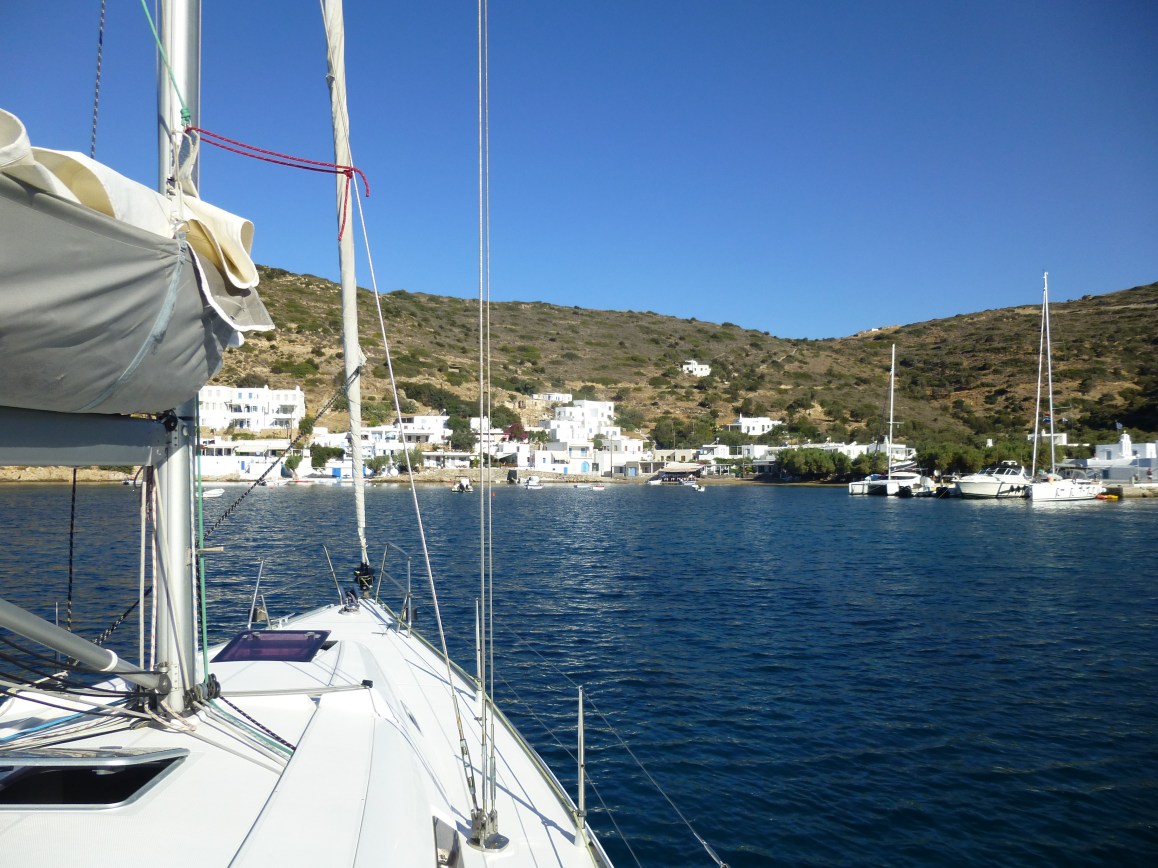
Again we sail with only the power of the wind, four of us taking our places on the windward side. I love this spot on the side of the boat, watching each swell approach. Some of the swells break against the hull and send a wave of cool water over us as we laugh and squeal like children at a water park. We arrive at Vathi salt-crusted, sun-warmed and eager for dinner at the waterside restaurant that Patrick has suggested.

We anchor in the middle of the bay surrounded by calm water, and even though there are a couple dozen other boats, it is peaceful here, a nice contrast to the vibrancy of Ios. Two tender rides from the Argo and we are all onshore. The water laps at a narrow shoreline as we walk – sometimes in the water – around the bay to a lovely restaurant under the trees. It has a perfect view of the setting sun.

We order from across the menu a wide selection of Greek specialities – lamb, octopus, squid, stuffed vegetables, tzatziki and olives. We are particularly impressed with the wine selection, and the first bottle of Assyrtiko is so delicious we order a second bottle almost straight away. Around us, families – many of them Greek – enjoy the serene setting, delicious food, and warm evening breeze. Under the table, I cheekily feed a ginger cat who has hungry kittens in a nearby tree. It’s a lazy, enjoyable meal. We walk even more slowly back to the tender, full from our feast and ready for bed.
P1020169

P1020162

Day Five

It will just be a short jaunt today, around the coast of Sifnos to Kamares. Kamares is a larger port than Vathi, with a wide sandy beach of golden, glittery sand and whitewashed buildings that climb up the hillside from the water. We moor in the middle of the bay and Patrick ferries us to shore on the tender for a day of exploring. Not knowing our destination, we follow Patrick onto the local bus where a few Euros each will get us across the island to Platys Gialos.

P1020177-edited

Sifnos is just beautiful. The roads to Platys Gialos are winding, and the bus rises to the top of hills and dips into the valleys. There are homes, farms, small towns and windmills – some working, some decorative. We share the crowded bus with travellers and locals, and at each stop the passengers manoeuvre up and down the aisle trying to get off or find a seat. I hear “excuse me” in many languages.

When we emerge from the bus the sun is high in the sky and warm on our faces. Collectively, we are parched and hungry. Fortunately, and I am guessing this is by Patrick’s design, we are across from a row of restaurants that back onto the beach. We choose the closest one and from our table we can almost dip our toes in the sand. The beach, unlike Vathi the night before, is brimming with people, mostly Greek families. This is a popular travel destination for Greeks, especially those from the mainland. Our waitress is delightful and the menu offers an array of fresh vegetables and seafood. I cannot resist the fried anchovies, so don’t. They are delicious.

There is a laziness to the afternoon, and we eat leisurely before heading back to the bus stop to catch a bus in the other direction. There is another stop on our itinerary before we will go back to the boat and get changed for dinner. Patrick promises us there will even be time for a swim later that afternoon.

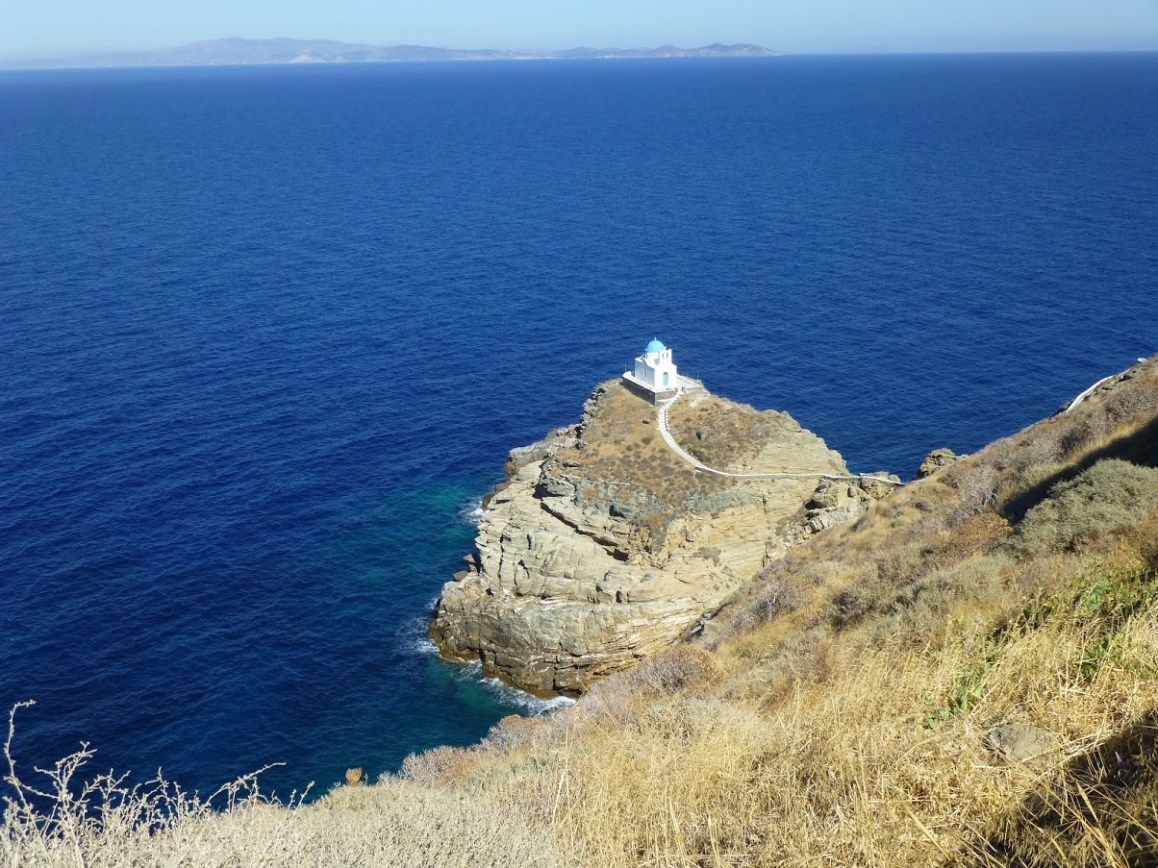
Two busses get us to Kastro, a fortress town perched high on a hill and with views on all sides. We walk the perimeter of the town, Patrick in the lead, and see Roman-built walls too old to fathom, amongst the whitewash and bougainvillea. Stray cats gaze at us lazily from vantage points. As we round a corner, we see a tiny white church balanced on an outcrop of rock far below us and just above the sea line. Waves crash close by, and we can just make out the path that leads to it from the town.
P1020173

The tour is quick, as it is not a large town, and we await the next bus – more than an hour away – at the Dolci Café. It overlooks farms that dot the valley, and the cocktail list is impressive. So is our waiter, who is rightfully arrogant about speaking five languages fluently, and an entertaining conversationalist. The cocktails are excellent and the time passes quickly.

Two more busses deposit us back in Kamare and Patrick is right, he has left us enough time to swim before changing for dinner. The water is warmer here than anywhere we have swum before and we can see a nearly-full moon rising over the hills before the sun even sets.

Dinner that night is in Apollonas, a gorgeous town in the heart of Sifnos. It is reminiscent of Mykonos, with whitewashed buildings and cobbled pathways leading off the main square in a tangle of walkways and alleys. Families, couples, groups of friends, travellers and local alike, fill the town with an intoxicating energy. The shopfronts boast beautiful wares from artisans and jewellers, and clothes in flowing fabrics and vibrant colours.

The choice of bars, cafes and restaurants is overwhelming, and thankfully we have a reservation where we will sit on a terrace overlooking the excitement. The wine is great, the food is fantastic and collectively, we never seem to run out of things to talk about. We will split up after dinner, some of us to shop, others to grab a drink at a local bar. Late that night we meet back at Kamare to ferry to the boat. It has been our busiest day, and it has been exquisite.


Day Six

A day of sailing to Kythnos where we will moor in a beautiful cove surrounded by jagged rocks and caves called Ormos Kolona. It is a popular spot, but the beauty of sailing is that even with neighbouring boats – big and small – the cove is peaceful and the atmosphere friendly. The water here is so clear we can see straight to the bottom, and several of us swim to shore to indulge in the natural hot springs.

We commute via tender to the only restaurant in the area, a lively place where you can meet your fellow travellers and even dance, if you feel like it. The moon is full now and hovers over the cove, with long milky fingers stretched across the water. It is our last night together and we enjoy a nightcap when we arrive back at the boat after dinner.

20160818_211124.jpg


Day Seven

To Athens. It is a long day of sailing, but we are well and truly seafarers now, deftly moving about the boat executing the Skipper’s orders. We sail via Cape Sounion, the southernmost tip of mainland Greece where the Temple of Poseidon reigns from on high. It’s a perfect spot to stop for lunch sheltered from the strong winds that have carried us back from the islands.


As we get closer to Athens, civilisation emerges in small increments, and soon enough we are sailing past the long beach and apartments blocks of Glyfada. Athens spills out across the valley in front of us, climbing part way up the surrounding hills. Soon we can make out the Acropolis and Mount Lycabettus. The marina that welcomes us is the busiest place we have seen in a week.

20160819_175226

We dock, we pack and chat, and when it is time to say goodbye, it feels like we are leaving family. There are hugs and promises of emails and photo-sharing to come. As my partner and I climb into the cab that will take us to the airport, I feel contented. It was an incredible week of exploration, relaxation, adventures and just being. Wonderful.
 

With thanks to Ben Reierson for some of these images.