Where the winds take you

A year ago, Ben and I were about to embark on a journey back to the Greek Islands, revisiting some of the places we discovered together in 2006 – when we met.

Our skipper from the sailing trip in ’06, Patrick, would be at the helm again. We’d get to see new places, we’d make new friends, and we’d celebrate a decade since we first met on the pier in Santorini.

This is about where the winds take you…

There’s something rather magical about going where the wind takes you, quite literally. The cares and stresses of everyday life ebb away, and the present becomes everything. Briny air, inky blue swells, and a wind that carries you and your fellow sailors to the next port. It’s freeing.

Seven people, one yacht, five Greek islands and one incredible week.
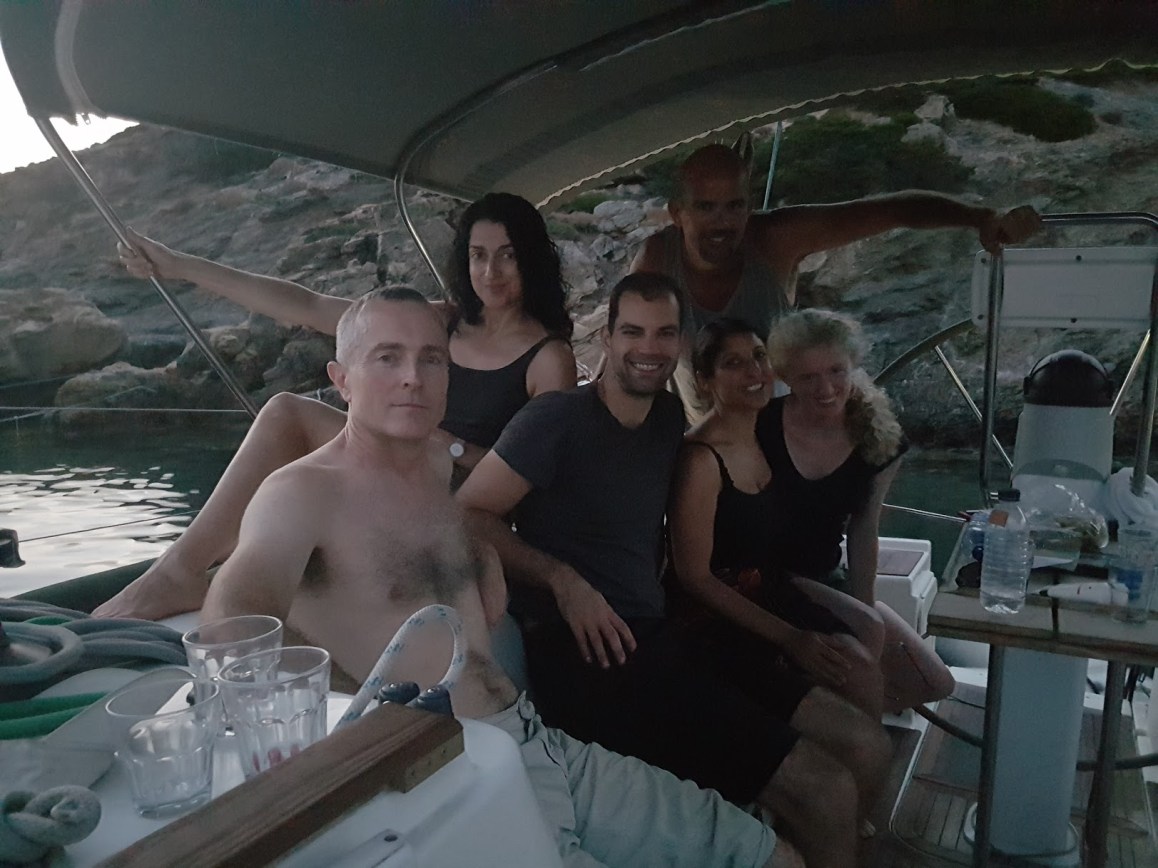
Group pic - sailing trip

Day One

We meet with eager faces at the port of Vlychada on the southern coast of Santorini. The marina is abuzz with energy as dozens of people chatter loudly and mill about between the dock and their vessels, a mixture of pleasure craft and fishing boats. The weather is a perfect 28°C with a warm breeze and only a few clouds in the vibrant blue sky.

Our Skipper, Patrick, shows us to our boat, the Argo, and we take turns to climb aboard and explore below deck, unpacking what we can into cubbies and stowing our luggage. The Argo will be our home for the next week. I take off my watch and stash it away, because I won’t need it today. Time moves differently when you’re on a boat.
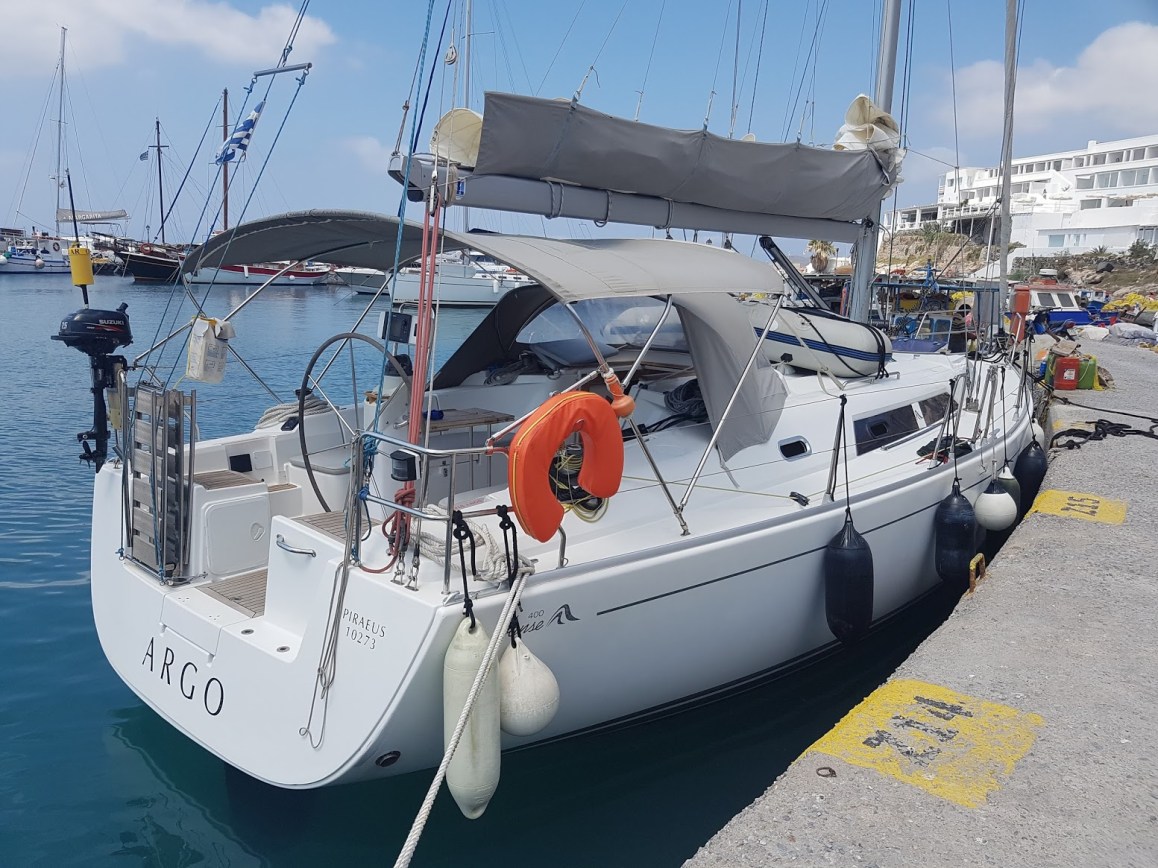
Our boat

We are seven, including Patrick, our ages ranging from mid-30s to mid-50s. We are across industries and continents in our everyday lives, but for the next week we will be the Argonauts, as dubbed by our Irish boatmate almost as soon as she is aboard. Both her laugh and instant camaraderie are infectious.

Tonight, we will anchor just off Akrotiri on Santorini, as the winds will be more favourable for our sail up to Ios in the morning. None of us mind. The view is beautiful and we enjoy swimming off the boat in the deep Oxford blue water. Colours, particularly of the water, will be important to the Argonauts, because every day we sail, the Aegean will reveal its vast palette and we will discover that the waters off each island are distinctive.

We watch the sunset over the island, and then break into two groups for a short ride to shore on the tender. I’m in the first group and we pull up at a restaurant where the tables are surrounded by water on three sides. A tall waiter sees us coming and hurries to help us ashore, a task that sounds simpler than it was, with the water line 3-feet below him. Patrick returns to the Argo while four of us get settled and devour the menu with our eyes.

When the others join us, we order practically one of everything and chat amiably over fresh seafood, deep red and delicious tomatoes, and tangy dips with crusty bread. We drink table wine, which is surprisingly drinkable. We don’t finish everything on the table, but we are full and when the sun completely disappears, we make our way back to the Argo. It takes only a few minutes to get used to the gentle rocking as we drift asleep.


Day Two

Sailing through the caldera offers a magnificent view not just of Santorini, but also of Thirasia, the island sitting opposite, and the ever-evolving Palea Kameni which is situated in the caldera’s centre and was site to the cluster’s most recent eruption in 1950. Looking up at Fira and the other towns that cling to the rock faces, you can’t help wondering how they stay there and what feats of engineering got them built in the first place. It’s stunning.

We moor for lunch in a cove just off Thirasia with a perfect view of Oia, the town perched on Santorini’s northernmost point. The water here is cooler than off Akrotiri, but after a simple lunch of tomatoes, bread, tzatziki and cheese, we swim off the boat until we’re called back aboard by our Skipper. For the first time, we will be solely under sail as we begin our trip north to Ios.

Patrick gives orders to his crew of civilians with the ease of someone who has done this many, many times before. With his guidance and good humour we make ourselves useful, raising the sails and setting course for the port of Ios. Once underway, he directs several of us to sit on the windward side of the boat. It will make us sail faster and is also a better spot for those of us with seasickness. Some of us – me included – do not have our sea legs yet.

The undulating sea is mesmerising and the seasickness does recede as we talk about nothing and everything. We will find that we form friendships quickly with so much concentrated time to get to know each other. Every once in a while, as we change tack, there is a burst of energy as we’re all given something important to do.

Ios emerges in front of us through a low haze, and before long we can make out the brilliant white of a church standing guard at the entrance of the port. As we get closer to our destination, we erupt into action as we make ready to dock. The port is crowded, but we ease into a berth between a luxury yacht and another sailboat, its Italian skipper lending a helpful hand as we secure our moorings. I am fascinated by the easy camaraderie of the two skippers despite being strangers and not speaking each other’s language.

Docked in Ios

Ios is bustling. It reminds me of Fira, only the crowd here seems to be mostly of twenty-somethings. We’re here for dinner, then to sleep the night and we will be off after breakfast. In the interim, we must shop for the following four meals, and will be on water rations until we reach another serviced port in two nights’ time. Patrick’s promise of a spectacular and secluded spot to spend our third night has us intrigued.

Dinner that night is close to where we have docked – we can see the Argo from our seats – and we order cheap, traditional food. Once again we don’t clear our plates, because it is so plentiful. Ios is alive. Children play loudly nearby as we eat, adults laugh and toast each other, and there is a thrum of energy. At a time when I would typically be asleep, it seems like Ios is just getting started. After dinner, we seek out the ice cream parlour and wait in a long, but fast-moving line. The ice cream is excellent and more reminiscent of gelato.

I wonder at being able to sleep aboard a boat docked in such a busy marina, but lull of the rocking sends me off peacefully.

Day Three

The supermarket is busy, extremely busy. The narrow aisles are crowded with goods and tourists. We have a long list and four of us are navigating with two trolleys. We need four meals, snacks, bottled water and drinks – wine and beer. One of us knows a bit about Greek wine and is scouring the wine aisle for some good picks. We check out having spent far less than we’re all used to spending in our respective home countries, and the frenzy of the market will prove a vast contrast to the second half of our day.

We are heading towards a secluded bay on the island of Dhespotiko, a spot Patrick found on his last trip. The sail is shorter than yesterday’s and I find that I am acclimating to the rhythms of the Aegean and finding my sea legs.

As promised, the hidden bay is incredibly beautiful. The island rises sharply from the water on either side of the narrow bay and is covered in reddish rocks and tufts of green. We anchor just off a small sandy beach and are the only boat in sight. The water is clear and we can see to the sandy depths. One of us, David, is a diver and he gears up to set our moorings below the water. The rest of us swim or prep for dinner.

P1020146

It takes a few runs with the tender to ferry all of us, along with the fixings and tools for a BBQ, across to the beach. Tonight, we will eat by moonlight, a selection of meat, seafood and vegetables grilled under the stars. The warm water laps at the tiny shore and we mix cocktails of spirits and juice, sipping from plastic cups as we watch the sun go down. The food is incredible, as is the reflection of the moonlight on the small bay. We laugh and talk and poke sticks into the fire. Late at night, Patrick ferries us back to the boat for a very quiet night’s sleep.

Day Four

We are in no hurry to leave the unnamed bay the next morning, all of us wanting to get the most out of this unique location. Some of us swim, others set off to climb the giant hill that overlooks the beach. Even from only half-way up the vantage points will produce some incredible photos. The Argo is a long white sliver in an arrow head of vibrant blue, both cupped by rugged red earth. After following a goat track back down the hillside, I leave my camera, shoes and clothes in the tender and swim back to the boat from shore. It is exhilarating being in this water. I want to stay all day.

P1020153

Eventually, it is time to leave and we say goodbye to what our Irish boatmate has now dubbed Artemis Bay, in honour of the moon goddess who provided such great lighting for our beach party the night before. Our next stop is the port of Vathi on Sifnos.

Again we sail with only the power of the wind, four of us taking our places on the windward side. I love this spot on the side of the boat, watching each swell approach. Some of the swells break against the hull and send a wave of cool water over us as we laugh and squeal like children at a water park. We arrive at Vathi salt-crusted, sun-warmed and eager for dinner at the waterside restaurant that Patrick has suggested.

We anchor in the middle of the bay surrounded by calm water, and even though there are a couple dozen other boats, it is peaceful here, a nice contrast to the vibrancy of Ios. Two tender rides from the Argo and we are all onshore. The water laps at a narrow shoreline as we walk – sometimes in the water – around the bay to a lovely restaurant under the trees. It has a perfect view of the setting sun.

We order from across the menu a wide selection of Greek specialities – lamb, octopus, squid, stuffed vegetables, tzatziki and olives. We are particularly impressed with the wine selection, and the first bottle of Assyrtiko is so delicious we order a second bottle almost straight away. Around us, families – many of them Greek – enjoy the serene setting, delicious food, and warm evening breeze. Under the table, I cheekily feed a ginger cat who has hungry kittens in a nearby tree. It’s a lazy, enjoyable meal. We walk even more slowly back to the tender, full from our feast and ready for bed.
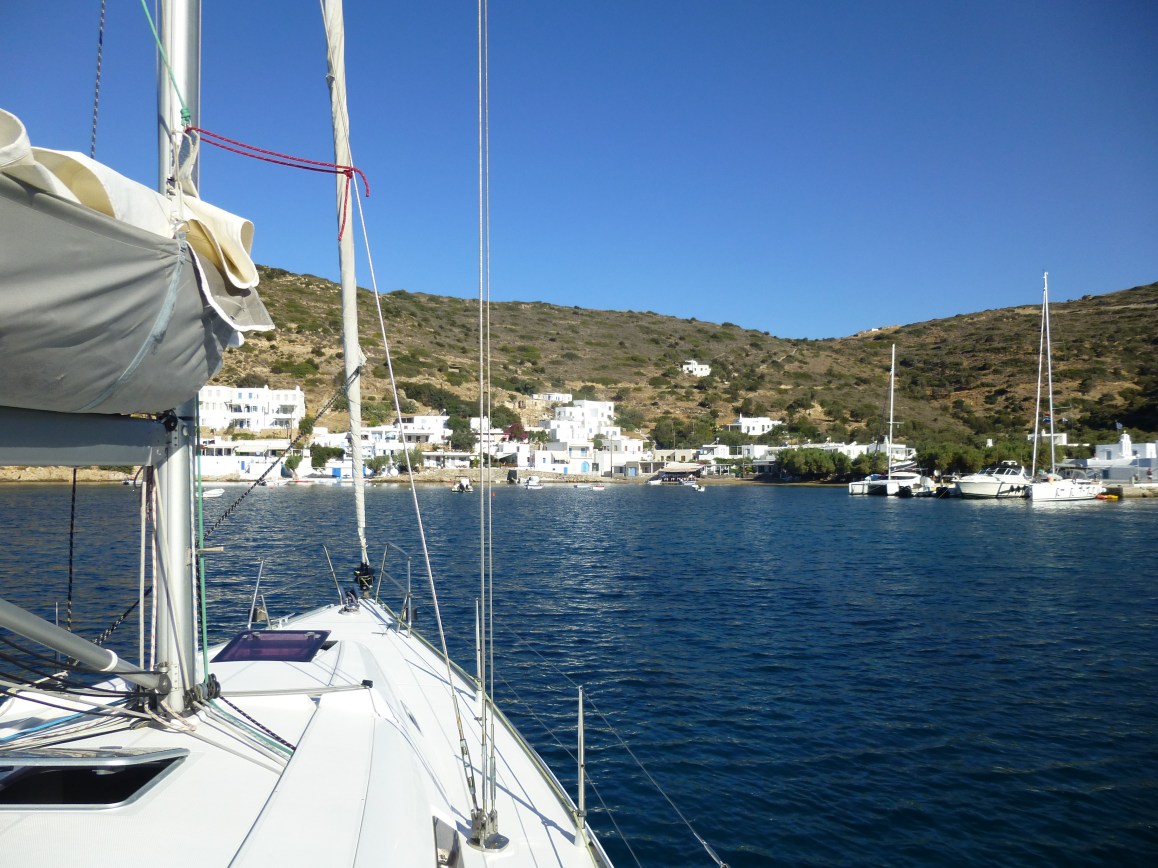
P1020169

P1020162

Day Five

It will just be a short jaunt today, around the coast of Sifnos to Kamares. Kamares is a larger port than Vathi, with a wide sandy beach of golden, glittery sand and whitewashed buildings that climb up the hillside from the water. We moor in the middle of the bay and Patrick ferries us to shore on the tender for a day of exploring. Not knowing our destination, we follow Patrick onto the local bus where a few Euros each will get us across the island to Platys Gialos.

P1020177-edited

Sifnos is just beautiful. The roads to Platys Gialos are winding, and the bus rises to the top of hills and dips into the valleys. There are homes, farms, small towns and windmills – some working, some decorative. We share the crowded bus with travellers and locals, and at each stop the passengers manoeuvre up and down the aisle trying to get off or find a seat. I hear “excuse me” in many languages.

When we emerge from the bus the sun is high in the sky and warm on our faces. Collectively, we are parched and hungry. Fortunately, and I am guessing this is by Patrick’s design, we are across from a row of restaurants that back onto the beach. We choose the closest one and from our table we can almost dip our toes in the sand. The beach, unlike Vathi the night before, is brimming with people, mostly Greek families. This is a popular travel destination for Greeks, especially those from the mainland. Our waitress is delightful and the menu offers an array of fresh vegetables and seafood. I cannot resist the fried anchovies, so don’t. They are delicious.

There is a laziness to the afternoon, and we eat leisurely before heading back to the bus stop to catch a bus in the other direction. There is another stop on our itinerary before we will go back to the boat and get changed for dinner. Patrick promises us there will even be time for a swim later that afternoon.

Two busses get us to Kastro, a fortress town perched high on a hill and with views on all sides. We walk the perimeter of the town, Patrick in the lead, and see Roman-built walls too old to fathom, amongst the whitewash and bougainvillea. Stray cats gaze at us lazily from vantage points. As we round a corner, we see a tiny white church balanced on an outcrop of rock far below us and just above the sea line. Waves crash close by, and we can just make out the path that leads to it from the town.
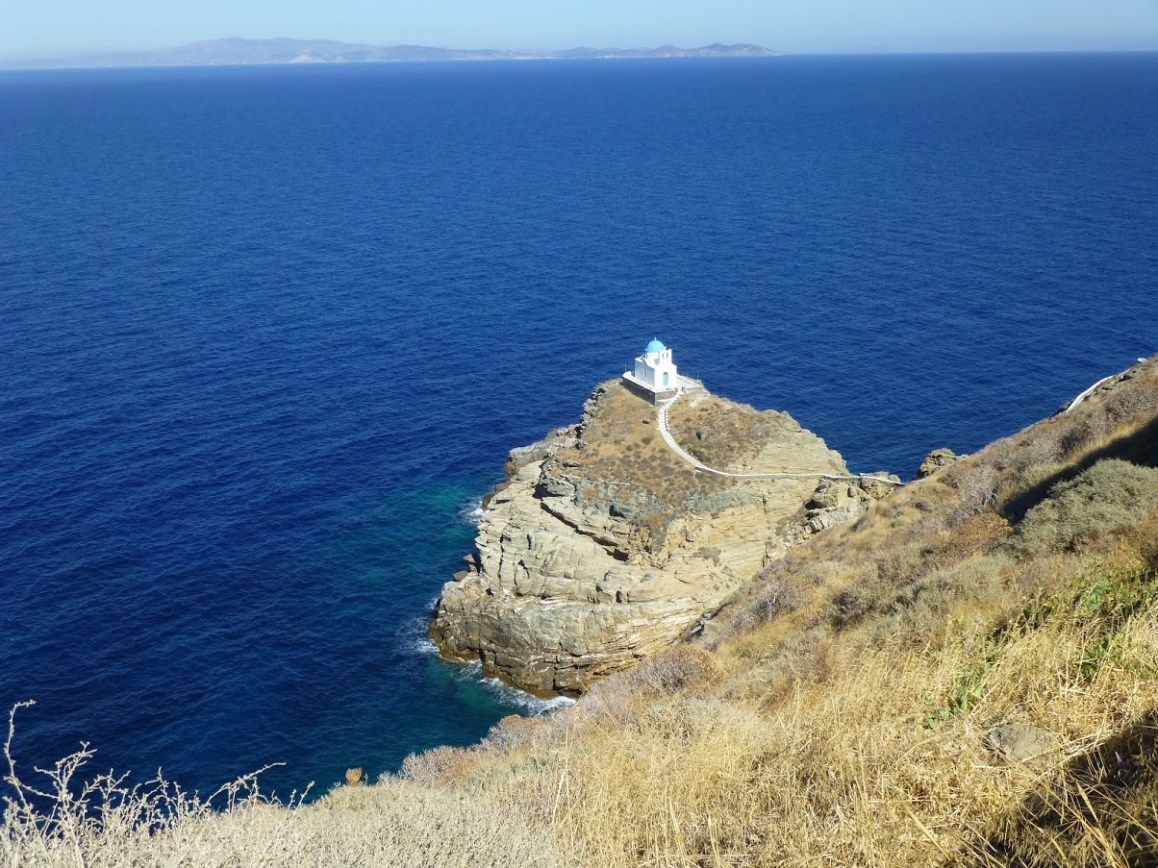
P1020173

The tour is quick, as it is not a large town, and we await the next bus – more than an hour away – at the Dolci Café. It overlooks farms that dot the valley, and the cocktail list is impressive. So is our waiter, who is rightfully arrogant about speaking five languages fluently, and an entertaining conversationalist. The cocktails are excellent and the time passes quickly.

Two more busses deposit us back in Kamare and Patrick is right, he has left us enough time to swim before changing for dinner. The water is warmer here than anywhere we have swum before and we can see a nearly-full moon rising over the hills before the sun even sets.

Dinner that night is in Apollonas, a gorgeous town in the heart of Sifnos. It is reminiscent of Mykonos, with whitewashed buildings and cobbled pathways leading off the main square in a tangle of walkways and alleys. Families, couples, groups of friends, travellers and local alike, fill the town with an intoxicating energy. The shopfronts boast beautiful wares from artisans and jewellers, and clothes in flowing fabrics and vibrant colours.

The choice of bars, cafes and restaurants is overwhelming, and thankfully we have a reservation where we will sit on a terrace overlooking the excitement. The wine is great, the food is fantastic and collectively, we never seem to run out of things to talk about. We will split up after dinner, some of us to shop, others to grab a drink at a local bar. Late that night we meet back at Kamare to ferry to the boat. It has been our busiest day, and it has been exquisite.


Day Six

A day of sailing to Kythnos where we will moor in a beautiful cove surrounded by jagged rocks and caves called Ormos Kolona. It is a popular spot, but the beauty of sailing is that even with neighbouring boats – big and small – the cove is peaceful and the atmosphere friendly. The water here is so clear we can see straight to the bottom, and several of us swim to shore to indulge in the natural hot springs.

We commute via tender to the only restaurant in the area, a lively place where you can meet your fellow travellers and even dance, if you feel like it. The moon is full now and hovers over the cove, with long milky fingers stretched across the water. It is our last night together and we enjoy a nightcap when we arrive back at the boat after dinner.

20160818_211124.jpg


Day Seven

To Athens. It is a long day of sailing, but we are well and truly seafarers now, deftly moving about the boat executing the Skipper’s orders. We sail via Cape Sounion, the southernmost tip of mainland Greece where the Temple of Poseidon reigns from on high. It’s a perfect spot to stop for lunch sheltered from the strong winds that have carried us back from the islands.


As we get closer to Athens, civilisation emerges in small increments, and soon enough we are sailing past the long beach and apartments blocks of Glyfada. Athens spills out across the valley in front of us, climbing part way up the surrounding hills. Soon we can make out the Acropolis and Mount Lycabettus. The marina that welcomes us is the busiest place we have seen in a week.

20160819_175226

We dock, we pack and chat, and when it is time to say goodbye, it feels like we are leaving family. There are hugs and promises of emails and photo-sharing to come. As my partner and I climb into the cab that will take us to the airport, I feel contented. It was an incredible week of exploration, relaxation, adventures and just being. Wonderful.


With thanks to Ben Reierson for some of these images.


Guest Blogger (My Awesome Mother): Changing the face of teaching in the 70s and 80s

My sister and I grew up with young parents. Mum and Dad were 21 when I was born and 25 when my sister came along. They were both primary school teachers. 

We grew up in the 70s, surrounded by 20-somethings – our parents and a slew of aunties and uncles – actual and honorary. 

When I was in Year 2, I changed schools so I could attend the school where my mother taught. I gained more aunties, friends of my mother, women who I looked up to, women who were kind to me and let me be my precocious self.

They – and my mother –  taught me that working in a professional role was normal for a woman. I had no idea then the type of blatant sexism they faced. Embarrassingly, I had no real idea what they faced until recently when my mum sent my sister and me an email.

This is what she wrote about her early years in the teaching profession:

I know you love stories about the women who work hard to make equality a reality. As you probably know, when your dad and I started our careers, women earned less, even though we were both teachers and had started working at the same time. The gap was significant – about $5000 per year.

Female teachers had to wear dresses, or skirts and high heels. No pants. Women were not entitled to maternity leave. Instead, we could resign and then re-apply for our jobs when we wanted to come back to work. I was fortunate enough to have 3 months at home with both of you before I had to go back to work. In staff rooms, we had assigned seats. There was an obvious and patriarchal hierarchy and at my first school. The men sat together and the women sat together.

Early on, I became a union member to help expedite a shift to equality.

What I did:

1) I worked diligently at my first school to ensure the female deputy principal allowed women to wear pant suits, especially with those who taught smaller children, and needed to sit on the floor at times.

Eventually, this policy passed and we could wear pant suits – on the proviso we did not just wear slacks and a top. When other schools found out, women there were allowed to wear pant suits a those schools as well. I suppose those women spoke up about the practically of it, like I did.

2) In the staff room, I refused to sit in ‘my spot’. I kept sitting in different chairs, because I knew that women should be able to talk to whoever they wanted, including the male staff members. Eventually, everyone moved about daily, and ignored the assigned seats policy. It was much more pleasant – we were all teachers, after all.

3) At another school, I worked hard to convince the principal that I could teach Science to all the senior primary students (Year 4, 5, and 6). At that time, this was considered a man’s job. I was successful; I got to teach Science.

4) As a Union Rep, I lobbied for better pay, better conditions, and more opportunities for women. I marched and I went on strike, along with many of the men and women I worked with. We lost pay, but we didn’t care. Our cause was too important.

5) At a rural school, only boys were allowed to wear pants, while girls had to wear skirts, even during the cold weather of winter. After many meetings with the administration and with the Parents and Citizens’ Committee (the P&C), we had a win and girls could also wear pants to school.

6) I initiated non-gender-biased clubs at every school I worked at. If girls wanted to learn about science, or if boys wanted to learn to sew, great. Any interested student was welcome and encouraged to develop their skills and interests.

7) At a school I taught at in Queensland, some sports were girls only or boys only. I fought to change that by working closely with the administration and the P&C.

8) As I taught in a lot of rural schools, there was often the issue of not having enough of one gender to fill a sports team. So, I introduced mixed teams at these schools. Then other schools started to do this. I was criticised, but again I didn’t care. Students were able to compete in sports that with other schools – that was what mattered.

9)  For too many years, women were not considered competent or skilled enough to teach upper grades. I rejected this idea, and was fortunate to have support from many of my principals. I would ask for an upper grade, so I could prove that women could competently teach those grades.

I worked very hard to get equal pay equal and equal opportunities for women over the years.  It wasn’t just me, but I was there, putting up my hand and speaking up. I was called names, told off, and ‘put in my place’. But that didn’t matter.  I believe everyone deserves the chance to be equal in all things.

My conquests were small and some would say insignificant, but change happens when individuals – many individuals – stand up. The voice of one becomes the voice of many.

Thank you, mum, for leading the way, for taking a stand and surrounding us with wonderful female role models.

Thank you also to our dad, who is one of the most fervent feminists I know and who was an outstanding teacher. And thank you to our step-mum, who has only just retired after nearly 40 years as a teacher, and has also been a wonderful professional role model.

Side note: I taught for 14 years before changing professional direction in 2009. My sister is still a teacher – and so is her husband. #familyprofession


New Year’s Absolutions 2017

images

Every year I think of the (sometimes silly) promises I have made to myself – or the albatrosses of obligations I have somehow bought into – and absolve myself of them. This is in the spirit of seeking (only) joyful, authentic, positive pursuits, and releasing myself from the pursuits that make me resentful, angry or bored.

My absolutions for 2017:

Reading books that are boring. I have actually become good at this: putting down books that are not engaging enough. Specifically, I absolve myself of finishing John Grisham’s latest, The Whistler, about a (yawn) whistle-blower. I wanted to like this book. I have read and liked Grisham for 25 years. Except that this book is boring. I got 30% in and was using it to put myself to sleep each night. It’s still on my Kindle, but I will not finish it.

Watching TV shows that I don’t like – or stop liking. It’s 2017 and we are spoiled for choice. We can watch anything and everything. We can watch across genres and on demand. We can binge watch – binging on TV shows like they are giant bags of potato chips. In 2016, I started watching Mr Robot. It’s good TV – really good TV – only I got sick of the premise. I didn’t like characters. I can appreciate the writing and acting without liking the show, but I no longer watch it.

Instead, I watch shows I continue to enjoy because time is precious and life is too short to watch ‘bad’ TV (which also applies to good TV that you don’t enjoy anymore). In 2016, I also stopped watching Scandal, Grey’s Anatomy, Rosewood, and Last Man on Earth. TV I am (still) enjoying: This is Us, Designated Survivor, Outlander, Madam Secretary, Modern Family, and Brooklyn 99. Oh, and the 4 episodes of Gilmore Girls that popped up recently.

Eating vegan/gluten free/organic/dairy free/Ayurvedic/Paleo. For about 20 years now I have subscribed to the 80/20 rule for eating/drinking: 80% of the time, I eat low-fat protein, whole grains, fresh fruit and veggies and drink tea (green, red and black) and lots of water. 20% of the time, I eat and drink what I like. This works for me. I don’t need to be dairy free because I am not lactose intolerant. I don’t need to eat gluten-free because I am not celiac. I have IBS, which means I have to be careful about eating uncooked fruit and veggies, but other than that, I’m good. If you need to eat differently to me to be or feel well, I will wholeheartedly support you. But I will not subscribe to a new way of eating just ’cause – Pete Evans, you lunatic.

Moving up the corporate ladder. I don’t want my boss’ job. He spends the majority of his time creating spreadsheets, writing tenders and taking meetings. In fact he spends more time in meetings than I do out of them. This is not what I want to do. I work in education; I want to educate. Like most industries, moving up at my company will take me further away from the thing I love. 2017 will be about exploring the breadth of my role, and discovering what my counterparts around the world are doing and sharing with them what I do. I want to make a difference more than I want to make a profit. This does not bode well for someone who wants to move on up, so, it’s a good thing that this isn’t me.

What I do want to in the next year: I want to travel widely. I want write across genres and for different audiences. I want to be fit and healthy. I want to make more of an effort to see my friends and family. I want to make solid plans to live elsewhere, and/or to expand my role, and/or to take on another role. I want to continue to learn and grow and be challenged. I want to give. I want to love.

Absolving myself of these things and more will give me time and space to pursue my loves, my dreams, and the things that will make me happy.

On that note, Happy New Year, everyone. May 2017 be grand, full of adventures and challenges, and replete with love and laughter. Be well, and be happy.


We the people…don’t always get it right

Two political posts in a row…

button_1102_4_custom-92126f69017a5aea3d3b8fb0dcffdf30dbdd4c98-s6-c30

In the aftermath of Brexit, I am still reeling. As a dual Australian-British citizen, I can no longer dream about or plan an extended working stay or a semi-retirement in 27 European countries. There are dozens of political, economic and social implications still to be revealed. And most seem like they’ll have the power to adversely affect my young nephew, who lives in the town of Rugby, Warwickshire with his parents.

Watching Brexit from the sidelines of Australia, I wondered at the tactic to leave this critical and vastly-complex decision to the public. I keep asking myself, ‘What was Cameron thinking?’ The Stay and Leave campaigns both seemed to target emotion rather than providing information, with misinformation combated with fear-mongering.

So, how do you let an emotional public, or even worse, an ill-informed or indifferent public to make such an important decision, particularly when you’re not even compelling them to participate? Isn’t that the job – the complex and critical job – of elected officials? Are there some things that should not be left to the public to decide? Is this the ultimate SNAFU in the pursuit of democracy?

This isn’t ‘should we have Daylight Savings or not?’ This is the future of a country, of its people and its geographical neighbours. This was too important a decision to leave to the layperson.

And in the aftermath, we’ve seen a wave of ‘Bregret’ – people who voted Leave, but didn’t really understand the implications. Or even worse, we are seeing people publicly shamed for gross stupidity of the ‘extra sunlight from Daylight Savings will fade my curtains’ magnitude.

What did David Cameron do when he decided to ask the British people to vote???

On Saturday July 2, Australia goes to the polls for a federal election. Unlike our American cousins across the pond, our dominant political parties don’t stray too far from the middle. We have slightly left of centre (Labor), slightly left of that (the Greens), slightly right of centre (the oddly-named Liberals) and slight right of that (the Nationals, who form a Coalition with the Liberals). It’s essentially Shorten (Labor) vs Turnbull (Liberals) and politically speaking, they’re much of a muchness when compared with the Trump/Clinton dichotomy.

The biggest divides between the (slightly) left and (slightly) right are around Education – both parties believe it is important and will continue to throw buckets of money at it, but they have different ideas of how to spend the money and how many buckets full to throw – and Marriage Equality.

Both candidates believe that we should have Marriage Equality in Australia. In fact, when Turnbull ousted (idiot) Abbott, many Australians watched with bated breath to see him make history and call for a parliamentary vote on the matter. We knew that given the chance, parliament was very likely to pass a law allowing men and women to marry their same-sex partners. You know, a basic human right.

But he didn’t. He said he would, but he didn’t. His party didn’t want a parliamentary solution. And, I have to say, as much as I was relieved to see Turnbull take over from (idiot) Abbott, he wants to be PM more than he wants to do what he knows what is right, what he believes is right.

Instead, if elected, the Coalition will hold a plebiscite. I had to look up what a plebiscite is. Essentially, it is a non-compulsory ‘vote’ at the end of a lengthy (and often ugly) public debate, and the result does not compel the government to act on it – even if it is in favour of Marriage Equality, which is ultimately what the Prime Minster supports. Ridiculous.

So, why? Why are we going to the expense ($160m) so we can debate if a group of people can have a basic human right? Again, this isn’t whether or not we should have daylight savings – something that has gone to referendum in this country – a referendum being compulsory with a legally-binding result. Why are we treating a right with less importance than a preference?

I read this incredibly articulate article today by Brian Tobin called, “Australia doesn’t need a plebiscite on same-sex marriage – Ireland’s experience shows why.” Tobin makes this point:

“Placing the rights of a minority group in the hands of the majority seems almost ludicrous. A sizeable number of the electorate could simply vote against same-sex marriage without being properly informed in the way elected politicians would usually be when legislating.”

Penny Wong, a prominent Australian politician who has a daughter with her long-term same-sex partner, has spoken out repeatedly about the planned plebiscite. Ms Wong says, “A plebiscite designed to deny me and many other Australians a marriage certificate will instead license hate speech to those who need little encouragement…Mr Turnbull, and many commentators on this subject, don’t understand that for gay and lesbian Australians, hate speech is not abstract. It’s real. It’s part of our everyday life.”

I don’t always agree with political and social commentator Alan Jones, but I agree with his response to the question, ‘why should Australian be wary of a plebiscite?’ “Parliament. We select 150 in the House of Representatives to represent those 22 million people on critical issues such as this.”

And this  is a critical issue. This is a human rights issue and subjecting same-sex couples and their families to the type of scrutiny and bigotry that a plebiscite will most definitely bring, is a human rights violation – particularly when polls have told us that the majority of Australians either support Marriage Equality or are indifferent.

We elect representatives to parliament to represent us and to make decisions on our behalf. It’s their job. And that is why I cannot vote for the Liberals on Election Day. In the matter of ensuring a basic human right for all Australians, they simply will not do their job.


What it’s like being an Aussie in America during a presidential election

I moved from Sydney to Seattle, Washington in January 2009 – just in time to watch President Obama’s first inauguration live on TV. He had been elected by the largest turn-out of voters in American history, and for many people it was a signpost of a better time to come. The vice grip of the Bush-Cheney era, their warmongering and tampering with the world’s economy, was over. As I watched Obama take the presidential oath, I felt like I was letting my breath out after holding it a really long time. I wasn’t alone.

170px-BarackObamaportrait
Remember this hopeful guy?

Obama stepped in to lead the most powerful nation on earth, and it looked like real change was on the horizon. Early in his second year, he made this pointed remark about the Republicans’ economic policies:

“So after they drove the car into the ditch, made it as difficult as possible for us to pull it back, now they want the keys back. (Laughter.) No! (Laughter and applause.) You can’t drive! (Applause.) We don’t want to have to go back into the ditch! We just got the car out! (Applause.)” – May 13, 2010

Over the months and years, I watched as the Democrats lost their seats in congress, and the president was left to lead a discordant group who battled his policies on every front. The hostile congress created an impasse; Obama couldn’t get anything done. And it was frustrating. He was frustrated. That charismatic smile was nowhere to be seen; in its place was a taut line of exasperation.

president-obama-owns-earlier-marijuana-use-talks-legalization
Exasperated

And of course when Obama entered the next election to secure his second term, the Republicans jumped all over his inability to get anything done, all of his ‘broken promises’. A lot of people bought into that rhetoric. Other camps painted him with the ‘socialist’ brush, because socialism is a dirty word to many Americans – those people equate it with fascism.

I watched nervously, along with millions of Americans as his opponent, Romney, gained traction. On the surface, Romney may have seemed like a good guy – a religious family man who had worked hard to earn his vast fortunes – but his policies soon revealed him to be misogynistic, racist and classist. As well as wanting to repeal the law that gives women reproductive freedoms, Romney advocated trickle-down economics. This is the theory that if the rich get richer, their wealth trickles down in the form of more jobs for the poor. It’s been debunked by the International Monetary Fund and world-renowned economists, but try telling that to Romney – or to Mr Trump for that matter.

In the first presidential debate, Romney trounced Obama. It was as though Obama had given up the fight; at times, he just sat there and said nothing. It was terrifying. In the second debate, Obama showed up. This was the whip-smart, charismatic and likeable leader who’d won the last election.

At one point in the debate Romney carried on and on about a recent attack on an American embassy, and how the president had failed to call it out as an act of terrorism. Obama let Romney hang himself. “Go ahead, governor,” he said, and Romney started to doubt himself. The fact was that Obama had called it an act of terrorism, and Romney looked like a fool when the moderator corrected him. He never quite recovered and Obama won the debate.

Barack Obama And Mitt Romney Participate In Second Presidential Debate
“Go ahead, Governor.”(Photo by Spencer Platt/Getty Images)

But that was just one debate in a series; it was one battle in a war. When Romney was secretly filmed stating that 47% of the country were what we’d call here in Australia, ‘bludgers’, his disdain for the working and middle classes of the American people was undeniable – and yet his polling remained strong. We’re seeing this phenomenon in the current election. Every time Trump seems to make a misstep, he gains more supporters. This phenomenon is both baffling and alarming.

On election day in November 2012, my partner and I watched anxiously as the polls closed from east to west. States were either designated blue (Democrats – Obama) or red (Republicans – Romney). It’s a complicated voting system, but essentially, it does come down to numbers. If you have the most votes in the Electoral College, you win. I knew that the states with the last polls to close – Washington, California and Oregon – were all expected to ‘turn blue’, and that as the most populous state, California, was expected to call a very close election one way or the other.

When the election was finally called for Obama I actually cried with relief. I did not want to live in a country – or a world, for that matter – with that man at the helm.

Seeing a presidential election up close, my biggest take away is that US elections are exhausting. And not just for the candidates – how do they do all of that campaigning? – but also for the people living there. As we’re seeing right now, the lead up takes more than 18 months. 18 Months! That’s nearly as long as our last Prime Minister was in office. Thank goodness for the daily doses of Steven Colbert and John Stewart to ease the tensions. Australian readers, think Shaun Micallif, Waleed Aly, and Carrie Bickmore, if you’re not familiar with Colbert and Stewart – clever, often hilarious, commentators who make the unbearable bearable.

I am watching the current election with as much interest as the last one, even though I now live in Melbourne, because as we know, whatever happens in US politics affects the rest of the world in countless ways. President Trump? Trump makes Romney look like the sweetest, most charitable and forward-thinking politician ever.


For Our Little Miss Lucy

Lucy 2.jpg

When you get a pet, you know that it is very likely that you will outlive them. You risk the inevitability of them dying sometime in the future, because you know that before that happens, you will have the wonderful experience of being a furrent.

We had our little Lucy for nearly 5 years and she died peacefully at the vet’s office yesterday afternoon because her kidneys failed.

We adopted Lucy from a shelter in Seattle in 2011. I had been asking Ben about getting a cat for more than a year, and he finally relented saying we could go to the shelter to ‘look’. I had an inkling that looking would turn into getting, so I agreed.

The shelter had a no-kill policy so there were dozens of cats to choose from. There was even an offer that day to adopt a black cat for free. We checked out all the black cats, but none of them were ours. Then 7 year old Lucy caught our eye because A) she was very pretty and B) she was a chill little kitty who was lounging at the back of her cage rather than meowing like crazy for our attention.

When we approached her, she stood up, stretched and turned around to show us her butt. We both laughed out loud. We asked to cuddle her and when we did, she purred loudly and rubbed up against us. Then Ben pointed out that she matched our living room rug, and we both knew we’d found our cat.

It was a big deal for Ben to agree to get a cat. He’d never had one before – he was a dog person – and he was understandably nervous about possible bad cat habits she might have – like scratching and biting, ruining the furniture, general meanness and/or indifference, jumping on counters and spreading cat germs, and worst of all, sleeping on his face. Lucy turned out to be just as perfect at home as she was in the shelter – she had no bad cat habits.

She was affectionate – in fact, Lucy was borderline slutty. She’d flop in front of anyone with a pulse who walked on two legs, begging to be petted. She would happily sit on laps, purring loudly, or do ‘halvesies’ which was front paws and head on the lap, back paws and bum on the chair, also purring loudly. She’d stay like that all day if you let her. She took to sitting on Ben’s lap, staring up at him adoringly, as he worked. And if you were drinking something while she was sitting on you, she’d want to sniff it, just to see what it was.

She was funny – she’d catch sight of her tail and stare at it as if to say, ‘what the fuck is that?’ Then she’d pounce on it and chase it around and ‘round like dogs do. Like me, she loved leather handbags and shoes, but unlike me, her love of them bordered on obsession. I can’t tell you how many times we apologised to guests who’d abandoned bags or shoes near the door only to watch our cat making love to them – the handbags and shoes, that is. She’d rub up and down on them and purr like a mad little puss. When I planted potted herbs on our balcony, she’d took to having a morning constitutional where she’d stop and smell each herb. I didn’t know at the time that I was planting a garden for her, but I’m pretty sure that’s what she thought. She also thought birds and cats on TV were real, and would go around the back of the TV looking for them.

She was a total cat – she’d watch birds playing on the balcony and make this weird sound – ‘ah-ah-ah-ah’. I’d never heard a cat do that before Lucy, but apparently, it’s very catlike. She was terrified of thunder and fireworks, and would run into our bedroom and shove her fat little bottom all the way under the bed. We’d have to coax her out afterwards. She would plant herself in the middle of the living room, stick her leg in the air and start licking her nethers. When we’d laugh – as we did pretty much every time – she would stop and look at us as if to ask ‘What?!’ and then continue. She loved to be brushed. It was one of the two words she knew – the other was her name. Until she got sick, she’d come when called. She loved the red dot, the feathered thing on the end of the string, playing with shoelaces (we used to say that she was helping us get dressed), and watching her favourite TV show called ‘The Back of the Red Couch’.

Lucy was fun to have around, loving and sweet, and she made us laugh. She was family and we will miss her. Here’s to you, Miss Lucy, and 5 wonderful years together.


P1040740

I’m hopeless at being helpless

catPatient

I am writing this one-handed and I’m wearing pyjamas in the middle of the day.

Eleven days ago I had a shoulder reconstruction and since then I’m sporting bandages on my left shoulder and a sling. I have at least 3 more days off work in ‘complete rest’ mode, and then maybe I can start back at work doing light duties from home.

I have pain in my shoulder and arm and it is different day to day and hour to hour – throbbing, dull ache, sharp at the site of my stitches, not painful at all. They gave me really powerful painkillers, but these make me nauseous, so I’ve been OTC-only for a while.

The shoulder pain was expected and actually doesn’t bother me as much as limitations imposed on me as a patient recovering from shoulder surgery. I mean, I knew I wouldn’t be able to do a lot of stuff, but I wasn’t prepared for how that would affect me.

I don’t like it.

I am getting better at asking for help as I get older, but it is still hard for me. It is not a pride thing as much as me not wanting to trouble others with my needs. It’s probably a little bit of a pride thing too, because I am fiercely independent and self-sufficient. I do know the limits of my abilities and at those limits is where I ask for help, but the limits have suddenly and drastically changed.

Things you can’t do when one arm is in a sling and you can’t get your bandages wet and you can’t really lean forward and it hurts if you move too much:

  • make a meal – even putting cereal and milk in a bowl – this is a two-handed activity if you’ve been doing it that way your whole life, and can go very wrong if attempted one-handed – in the mornings, I sit at the breakfast bar and tell my boyfriend, Ben, how many flakes to put in the bowl – I am usually chief cook in our home so it’s frustrating not to be able to whip up dinner in 10 minutes like I usually do
  • wash my hair – the 1000s of times I took this simple activity for granted! My recent hair washing experiences have included plastic wrap, masking tape, the laundry sink, and for the first time ever, Ben
  • putting my hair into a pony tail – girls with long(ish) hair, try it – or even just mime doing it – you can’t do it alone. Ben can now do a neat low pony, but we have yet to graduate to the more advanced messy bun
  • drying off after a bath – when you’re an adult, bath time should be fun or a luxury – at the moment, it is neither – it is solely perfunctory – I feel like an overgrown toddler, needing help to wash under my right arm and to dry my back and legs
  • typing – actually I can do this – it just takes a looooooong time
  • car doors and seatbelts – sure, I can open the car door one-handed, but when I did it hurt like hell – I realised how much that one action relays to my other shoulder, so in this condition, it’s best done by someone else so I don’t bust a stitch
  • opening jars, bottles, etc. – see ‘car doors’ above
  • washing dishes – see ‘opening jars’ above
  • walking – yep, walking hurts – you move a lot of your body when you walk, and here’s a shocker, your body parts are all connected! Ow!
  • carrying – you can can more with 2 hands together than with 1 hand x 2 – this means lots of trips when moving rooms – and see ‘walking’ above
  • working out – I know this is an obvious one, but daily exercise has become vital for my general wellbeing – it gets the kinks out of my body and my brain – I rely on the endorphins, I like being flexible and strong – it keeps the aches and the blues at bay
  • general chores and stuff you do around the house 50 times a day without thinking – I am bumping up against this one a lot

How have these limits on my self-sufficiency affected me?

If I’m honest, I’m a little blue. I don’t like being helpless. I am a doer. I get shit done. All I have gotten done in the last 11 days is read 4 novels, watch 3 complete series on Netflix, trawl Facebook and Reddit 3 times a day, and develop an excruciating headache that sent me to bed for 2 days.

And healing.

I am very busy healing, and even though my current state frustrates me, I know this is my number one priority. I must heal so I can get back to doing all the other stuff.

Very special thanks to my darling Ben who has become my left hand. And thank you to friends for visits and driving me to the doctor and helping me do stuff I can’t do by myself at the moment.


The hardest part is getting published

Writing a novel may seem like a big task. It is.

Start to finish, including chapter re-writes, incorporating feedback from trusted editors and reviewing the whole thing 3 times over, You Might Just Meet Someone took about 2 years. That’s 2 years alternating between intense labouring and equally intense procrastination.

You see, I love to write, but I don’t always feel like doing it. The majority of my job is writing – documents, training materials, reviews, editing – so when I get home from work, sometimes I don’t want to sit in front of another computer and do more writing. And of course when I get in the habit of browsing Reddit, watching Netflix or reading instead of writing regularly, it is easy to ignore the niggling voice in my head that says, “Sandy, this novel is not going to write itself.”

Well, it’s done now, and I have already started the outline for the sequel, but harder than writing and editing it, is getting it published.

Just like a novel doesn’t write itself, no one is going to knock on my door and say, “hello, I’m looking for a novel to publish. Do you happen to have one lying about in a drawer somewhere?”

No! It’s up to me. I have to get the word out!!

I need a publisher, or an agent, or both. Whichever one I get first will (probably) make it easier to get the other one, so I am working on getting a publisher and an agent at the same time. It’s a bit chicken and egg, really.

And you may not know this, but an aspiring author needs a brilliant book proposal, one that can be adapted for each potential publisher and agent, because they all want slightly different things.

Essentially, I need a detailed synopsis, a shorter synopsis, and a really brief synopsis – something that might appear on the back cover. Plus I need an engaging author’s bio which highlights my brilliance and my bankability, and to identify the target audience as well as competing titles – these are the books mine will sit next to on the shelf. Publishers and agents need to know what books are similar to mine – and in what way – as well as how mine is distinctive from other books.

I learned all of this from two incredibly brilliant women, Kerry and Jen from the Business of Books based out of Seattle. Between them they have written (and published) 40+ books, and because they both worked as publishers before they became authors they really know the biz of books. And they share what they know.

Publishing is a business and if I am going to make it my business, I still have work to do. Now begins the hard part.


Why Spectre Was a Giant Snore Fest

[Spoiler Alert!]

There’s no nice way to say this. Spectre is a silly and rather dull movie. Which for a HUGE Bond fan – particularly of the Daniel Craig era – is grossly disappointing. They say Craig is hanging up his Omega watch and bespoke suits and that they’ll be passing the Bond mantle onto someone else. Maybe that’s because this film was so silly and dull.

Let’s Talk About Sex

Bond has sex with two women in this film – the film’s first-ever Bond Woman, Monica Belluci, who is like a saucier, bedroom version of Nigella Lawson. Their scene was rather sexy – especially when compared with the nonsense that came later in the film – but there is absolutely no reason for it. She’s scared for her life, which Bond has saved, but she doesn’t seem particularly grateful about it, and I got the feeling she would have told him what he needed to know regardless of whether or not he’d stopped to check out her (incredibly nice) lingerie.

In fact, the sex makes him late for a VERY important meeting, which is the whole reason he is even in that part of the world. He’s being stupid – and Bond is not stupid. Reckless, sometimes, but never stupid.

The Bond Woman thing is a big deal, by the way. It is the first time in Bond history that Bond has seduced an older woman. Okay, Belluci is only a few years older than Craig, but still. And she really did rock that lingerie.

The other woman he has sex with is some blonde lady. I confess that I have yet to learn the actresses name, because she sort of blended into the background in every scene.

And of course she hates him when she meets him and sends him away and then he saves her life and she hates him some more and then they’re on a train, inexplicably dressed in the most beautiful clothes even though they’re most likely going to their deaths (cue the evil lair), and then they nearly  die, and then they have sex. In fact, they fight for their lives and then – both still impeccably dressed – they look at each other and say, “Now what.”

The ‘what’ is a cut-away edit to them tearing each other’s clothes off in a warmly-lit super spacious (i.e. non-existent) train cabin to SAXOPHONE music. Yes, really. And then of course she falls madly in love with him – not lust. Love. Good grief.

Bad Guys Always Lose

Christoph Waltz is the bad guy – this is a spoiler apparently, even though he is in the credits and all the previews, because for the first 15 minutes of his screen time, his face is hidden. This makes the big reveal – when Bond works out that the leader of this terrible faction is in fact his long-dead foster brother – a giant moment of tension and surprise. Only it isn’t. There is not ONE moment of tension or surprise in the whole movie – but I will get to that later.

Back to Waltz. I have seen him play one of the most horrifyingly evil basterds (sic) I’ve seen on films in years – (Inglorious Basterds, Nazi Officer), so he should be awesome as a Bond villain. Right?

Wrong.

He played the role as though he couldn’t have cared less. That’s not very scary. I’d say Waltz lost some credibility with this role – at least in my mind. And I adored him in Django – that performance leaves me in awe. Bleh.

Action!

There was some action, but nothing we haven’t seen done before – and better – in the Bourne films, the Mission Impossible films, Ronin, previous Bond films, The Italian Job, Fast and the Furious. Need I go on?

BO-RING! And having just re-watched Casino Royale, where that parkour chase scene at the beginning blew my mind again, I nearly fell asleep watching this film.

It was like watching Planes, Trains and Automobiles without the awesome script and terrific acting.

The plot

Is stupid. And makes no sense.

Fan Service

I heard that Spectre had a lot of fan service – these are juicy details there just because they will delight the fans. I was excited about this until I realised that most of it was directed at die-hard fans of the 1970s Bond films.

  • The Bond girl wears ridiculously impractical clothes for breaking into the evil villain’s evil lair, even though she knows she will likely have to run/fight for her life
  • Bond is strapped to some sort of torture device which makes no sense in the context of the plot (see above)
  • The evil villain has a white fluffy cat – yes really
  • The evil villain’s henchman doesn’t speak and he doesn’t die
  • There is a beautiful building on the top of a very pointy mountain
  • Bond never runs out of bullets but doesn’t carry extra ammo

Other Dumb/Annoying Things

  • When they destroy the evil guy’s lair – after the Scooby Doo-style confession of his giant evil plan – the destruction  seems to have no effect on the plan coming to fruition. This means that the evil plan needs to be stopped another way and that means the (stupid) trip to the desert on the train was pointless.
  • The style – the look – the feel – and the pace of the movie shifted drastically throughout. Sam Mendes couldn’t seem to make up his mind what kind of film he was making.
  • The (dumb) photocopied pictures of past characters in the finale. We’re supposed to believe that the evil villain is a BAZILLIONAIRE and he would stoop to using photocopied pictures? P-lease!
  • There were two secret hideouts for the same peripheral character. Que?
  • There were two bad guys and the second one was REALLY obvious from the outset. Why?

The good bits

  • The clothes were nice
  • The locations were nice
  • The Aston Martin was nice
  • Daniel Craig, nice to look at
  • M and Q and Moneypenny got some cool spy stuff to do
  • The theme song was rather nice
  • There were two (intentionally) funny bits – I liked those


You Might Just Meet Someone Chapter Two

On the flight to Athens, I was stuck in the middle seat between a husband and wife, one who wanted to sit by the window and the other who wanted the aisle. They spent the entire flight talking across me as though I was some sort of aeronautical soft furnishing. When I politely asked if they wanted to sit together, they scoffed. “Oh no, Love, we’re perfectly fine sitting apart.” I wasn’t perfectly fine. I was developing a tension headache, but they didn’t seem to care about that.

I figured if I was going to survive jet-lag, fatigue and my growing frustration with my seat-mates without having some sort of mid-air meltdown, I was going to need more tea. Tea calms me, tea revitalises me, tea is a miracle drink – tea drinkers will understand what I mean. Thank goodness it was a British Airways flight, because I knew they’d have the good stuff – proper English tea. I rang my call button three times during a four-hour flight and every time was to ask for more tea. This of course meant I had to pee twice, but I considered those few moments of silence a reprieve from Douglas and Sharon’s non-stop duologue.

By the time we landed at Athens airport, I knew every detail about their ungrateful adult children, their annoying neighbours – on both sides – and their suspicion of the newly re-elected government. Sure, I like to have a good whinge about things from time to time, like long-haul flying for instance, but these two took it to another level. I felt like writing to the IOC and suggesting that they add complaining to the Olympics. Maybe the Poms could finally win a haul of gold medals.

I made a point of losing them as soon as we got inside the terminal. I leapfrogged around other English tourists, striding purposefully towards immigration where I discovered two things: a massive queue and a slew of ridiculously handsome Greek men in uniforms. Apparently, the Greek government had hired a flock of Adonises – or is the plural, Adoni? – to man the immigration booths. This discovery made the first one much less annoying, and I waited patiently in line while appreciating some of Greece’s natural wonders. When it was my turn I handed my passport over and endured the handsome man’s scrutiny as he weighed up the Sarah in my photograph – slicked-back hair, no makeup and glasses – with the goddess in front of him.
As I met his gaze, I was glad I had kept the cabbie waiting a few minutes so I could tame my wayward curls into the semblance of a style and put on some blush and mascara. It’s not like I thought the immigration guy and I were going to run away together, but at least I didn’t look like a complete hag. My heart jumped a little at the sound of the Greek entry stamp being added to my passport. Then it jumped again when the Adonis smiled and welcomed me to his country. Moments in and I was already in love with Greece.


After being so warmly welcomed into the country, I found baggage claim, hauled my backpack off the baggage carousel, silently grateful that it had made the trip along with me, and headed through the doors into the transit lounge. The first thing that struck me was how hot it was. The second was the amount of smoke in the air; it looked like the transit lounge was on fire. Maybe I’d been a little hasty in declaring my love for Greece.

I mean the Greeks invented the wheel for crying out loud – and democracy! How had they not discovered air-conditioning or passed laws to ban smoking inside? I stifled a cough and peered through the haze. Spying an empty chair in a far corner, I made a beeline to stake my claim, which would have been easier had I not been lugging my luggage. I was too late. A different middle-aged British couple sat their duty free bags down on my seat, and then stood next to it complaining about how hot it was. Olympic-level whinging strikes again! Oh you dastardly Poms.

Changing directions, I headed to the nearest empty piece of floor. I plonked down my bag, and plonked myself down next to it, already starting to hate it a little. Why had I packed so much? Did I really need three bikinis?

I was also carrying a small leather backpack, which was stylish enough to be my handbag, and practical enough to be my day-pack. It had been a splurge right before I left for my trip, along with my duty-free Prada sunglasses. I regarded it lovingly, not caring if my backpack got jealous. Deep red-brown leather, brass clasps. It really was a thing of beauty. And, importantly, a handbag didn’t cheat on you with a slut from yoga class.

Four hours later – why did I think that a Greek island-hopper would depart on time? – I was seated in a very small plane next to a very large man who seemed to be turning into Kermit the Frog before my eyes.

“Sorry, ma’am” he said. Texan, I thought, identifying his origin from the two words – I’m talented like that. “I don’t usually fly on such small planes. I’m afraid I may need to get up to use the restroom.” Even in the throes of the worst air sickness I had ever witnessed, he was using his manners. Texans are so polite.

“Of course!” I unbuckled my seatbelt and stood in the tiny aisle. “How about I sit near the window, just in case you need to get up again?”

He nodded and then rushed up the aisle to the only bathroom on board. Poor man. At least it was a short flight. As I strapped myself into the window seat, I heard a chorus of ‘Oooohs’ from the other passengers. I looked out my window as the plane banked and there it was, Santorini, a crescent of rusty land in a sea of deep blue. It was stunning. I added my own involuntary ‘Oh’ to the voices of the others, as I felt a broad, relaxed smile spread across my lips.

“Sorry ‘bout that, ma’am,” I heard over my shoulder as the Texan sat down.

“Look,” I said, leaning back so he could see past me.

“That’s mighty pretty.”

I nodded in reply.

In just over a day I’d gone from the frenzy of three international airports to an idyllic island in the middle of the Aegean Sea. As we arced across Santorini on our approach to the airport, I could barely wrap my brain around how beautiful it was. The rugged red land contrasted with the brilliant blue of the sky and the stark white and creamy pastels of the buildings. It was so perfect, it took my breath away. By the time we landed I was practically hyperventilating.

Santorini’s airport terminal was kind of kitschy; it looked a Vegas hotel circa the 1970s. Not that I’d hung out in Vegas in the 70s – I was barely even alive then – but I’d seen enough movies to get that 70s vibe from the terminal. Inside it was cool and clean – that’s cool as in temperature, rather than hipness, although it had a little of that too. I noticed that everyone moved at a more leisurely pace than they did in the constant chaos of Sydney, as though someone had slowed a video playback just ever-so-slightly. I liked it.

My bag seemed to have gained even more weight in transit. I hefted it from the baggage carousel and said goodbye to the nice Texan. Emerging into sunshine, I waited in line for a taxi. And I didn’t mind – the waiting, that is. The island was already calming me. While I waited, I breathed in deep breaths of Santorini’s clean, briny air. It was the exact opposite of Athens’ air – or London’s for that matter.

Before I knew it, it was my turn. The taxi pulled up, the taxi driver got out and took my bag, stashing it in the boot, and I climbed into the backseat, giving him the name of the hotel I was staying at. These were all normal activities. And then we took off.

My state of Zen disappeared in an instant. Apparently, the taxi driver hadn’t gotten the memo about chilled-out island life.

The ride from the airport to the hotel was nothing less than a harrowing experience as we tore down narrow, winding dirt roads doing Mach II. The rugged landscape suddenly lost its appeal. In a crappy car going too fast, it felt more like I was in a car rally than on vacation. Only an hour before I’d been sitting in a teeny, tiny plane crossing the sea, and I’d felt much safer then, than I did in the back of that cab.

We pulled up at the hotel and I thanked Zeus that I’d arrived in one piece. I begrudgingly paid the cabbie and climbed out of the car. He retrieved my bag from the boot and before I knew it, he was gone, speeding off to the next fare, a cloud of dust in his wake.

I stood for a moment, regarding my location and catching my breath. I was in the heart of Fira, and with the amount of whitewash I could see, there was no mistaking that I was in Greece. I did a little self-congratulatory dance to celebrate being there. Greece!

Around me people ambled along the road, stopping to have leisurely and lively conversations with their neighbours. Across the road there were congregations at a handful of tavernas, each indistinguishable from the next to my uneducated eye. People sat at tables playing chess and cards, and smoking. Some drank coffee, some sipped clear liquid from tiny glasses. Ouzo, most likely. Laughter and chatter filled the air around me.

It occurred to me that it was the middle of the afternoon on a Thursday. Didn’t these people have jobs? Maybe the whole town was on vacation. Like I was. I was on vacation. The realisation hit me again, a wave of wonderfulness. The giddy dance took over again without me having to conjure it.

I picked up my bag from the dusty curb and walked up the path of my hotel. Inside, the small lobby was cool and the scent of bougainvillea wafted in from an open window. A lovely woman, who spoke little English and had a warm smile, greeted me at the front desk. After a simple check in – I showed her my passport and she gave me a room key – she led me to my small, neat room. It was basic, but I didn’t need anything more. I was only staying for one night.

It did smell slightly like a toilet, but I’d been to Greece enough times in my touring days to expect that. The Greeks don’t flush toilet paper; it goes into the little bin next to the toilet. Just like air-conditioning and not smoking inside, some modern practices had escaped the modern Greeks. It meant that many hotel rooms smelled just like mine. It was a minor blip. I’d survive.

I wouldn’t, however, survive much longer if I didn’t eat; I was dangerously close to starvation. Well, not actual starvation, but my appetite was definitely robust. Two packets of airplane biscuits and a gallon of tea did not a balanced diet make. And especially not when there was Greek food all around me just waiting to be eaten.

I stashed some valuables in my room safe and packed my leather bag for dinner followed by an evening of exploring. Leaving the hotel, I eyed the tavernas I’d seen across the road on arrival. The crowds in two of them were thinning out, as though the jobless folks suddenly had somewhere to be. At the third one, chess sets and ashtrays were being replaced with platters of food, and it looked like it was filling up with local diners. I consider that good sign whenever I travel, because locals tend not to go out for crappy food.

I crossed the road and took a seat in the taverna at a table for two near the kitchen. The smells coming out of there were unbelievable. My stomach grumbled with appreciation. A waiter appeared and stood patiently while I tortured him with my terrible Greek. I started with ‘kalimera’ – good morning – before correcting myself. “No, sorry, kalispera.” He just smiled and spoke to me in English.

“Good evening. I am Dimitri.”

“Hello Dimitri. I need horiatiki,” I said, not even looking at the menu. I knew it would be on there, because it’s what we non-Greeks call a Greek salad. “And lamb, do you have lamb?” He gave me a funny look. Of course they had lamb. “And giant beans.” I love giant beans. It’s a dish, by the way. I mean, the beans are big, but it’s essentially a stew made with beans. It’s the second-best thing in the world after horiatiki.

Dimitri gave me a smile and a nod, and then he offered me some retsina to go with my dinner. Greek wine. I declined. I am what you might call a wine lover, and as a wine lover I can’t really abide retsina. “I’ll have a Mythos, parakalo.” Greek beer – much more drinkable.

The salad came to the table within minutes and it was truly a thing of beauty. It looked like it belonged on the cover of a foodie magazine and it smelled incredible. I piled up my fork to get the perfect first bite. As soon as it hit my mouth I groaned with pleasure, half-expecting to hear, ‘I’ll have what she’s having,’ from the next table.

I need to explain something important.

The Greeks grow the best tomatoes in the world. And I know that I exaggerate sometimes, but I mean IN THE WORLD. Add to the best tomatoes in the world, some freshly-made feta, super virginal olive oil, fresh fragrant oregano, Kalamata olives grown in luscious Greek sunshine, and all the other bits of goodness that go into a horiatiki, and you have the one thing I could eat every day for the rest of eternity.

The lamb and beans arrived next and the lamb was so tender I could probably have cut just by staring at it. The giant beans were particularly huge and the sauce was rich and tangy. I glanced around me as I finished off all three plates. The taverna was now full – a few travellers like me, but mostly locals, who obviously knew where the good stuff was.

The food had impressed me and then the bill arrived. I thought it was wrong, but Dimitri assured me that 14 Euros was correct – for three plates of food and a beer. I wished I was staying on Santorini longer; I’d have happily eaten at that taverna every night for weeks.

When I’d planned the trip, everything I read about Santorini mentioned the sunset to end all sunsets at Oia, which is a tiny town perched on the northern point of Santorini’s crescent. With only 24 hours on the island, I’d added the Oia sunset to my list, and when I mentioned it to Dimitri after I paid my bill, he kindly he wrote down directions – in Greek and English. Smart.

Armed with my mud map and a full belly, I set off from the taverna to find the local bus station and the bus to Oia. It wasn’t difficult – Dimitri’s instructions were perfect – but to call it a bus station would have been generous. It was a dusty square filled with dusty buses.

I bought a ticket from a man who sat inside a grubby booth by holding up one finger and saying ‘Oia.’ He had a cigarette dangling precariously from his mouth, which he managed to inhale from without using his hands. Talented. I picked my bus out of the line-up – using Dimitri’s directions again – and climbed aboard.

As I waited for the bus to leave, I watched the stream of people passing through the square. I noticed a tall guy in a baseball cap, hefting a large duffle bag and trying to get directions from the passing locals. No one was stopping and he seemed frustrated. American. I could pick an American out at a hundred paces. He was a pretty cute American too.

He was tall – over six foot, I guessed – dressed in long shorts and a T-shirt. The T-shirt was just fitted enough to see that he had a lean, muscular body. Dark brown curls peeked out from the cap, and although he was wearing sunglasses and I couldn’t see his eyes, he had a general ‘good-looking’ thing going on. I would have stepped off the bus to help him had I not already bought a bus ticket to the sunset to end all sunsets. Not that I knew my way around any better than he seemed to, but he looked like he could use a friendly face.

The bus lurched forward – I hadn’t even noticed the driver get on – and my last glimpse of the tall, cute American was him throwing his duffle on the ground and sitting on it dejectedly. Poor guy. I promised myself that if he was still there when I got back, I’d go talk to him.

The sunset was beautiful by the way. I don’t know that I’d call it the best in the world – I mean, I’m from Australia and we do sunsets spectacularly well there – but I enjoyed it, especially the atmosphere. Within the town of Oia, smooth, curved, whitewashed walls of some houses contrasted with rugged stone walls of others. Walkways and steps separated the homes, and yards were marked with either rock walls or white picket fences. In the warm milky light, whitewash took on the colour of cream. It was a quaint and quintessentially Greek town.

I found a little spot where I could sit on one of the steps and gazed westward, taking it all in. The cooling evening air was deliciously fragrant, floral notes mixed with sea air. I took a slow, deep breath. Around me were hundreds of people, and the atmosphere was abuzz with chatter while we waited for the sun to set. Then in a single unspoken moment the crowd quietened; it was time. The spectacle changed second by second, gold slipping into amber, then crimson, then inky purples and blues.

I could almost feel my heartbeat slowing down.

When the sun disappeared completely and the last rays of light retreated, the crowd applauded as though we were at the symphony and the concerto had just ended. I clapped along with those around me. When in Santorini…

Neil would have loved that, I thought.

What?! Where the hell did that come from? Who cared what Neil would or wouldn’t love? I didn’t. And I certainly didn’t need my mind ambushing me with such disturbing, random thoughts! All of the serenity I had felt as I watched the sun seep below the horizon vanished instantly. Bloody Neil. I got up, dusted myself off and followed the others up the steps and onto the road back to Santorini.

Thankfully, a bus was waiting at the same place we’d been dropped off, and I climbed aboard along with about eighty other people. No seat for me this time – it was standing room only – but the tightly-packed group was in good spirits. As we jostled along the bumpy road back into Fira, I held on tightly to a hand rail and tried to shake residual thoughts of Neil from my brain. To distract myself, I trained my ears to the conversations around me, listening to the various languages and accents.

I was glad when the bus depot appeared in the glow from the headlights. Exhaustion had set in – both physical and emotional – and I desperately wanted sleep. I stepped off the bus, oriented myself and set off for my hotel. And yes, I forgot all about the cute American.

Back in my room, I locked the door behind me, slipped off my already travel-worn clothes and put on my pyjamas. Still concentrating on not thinking about Neil, I focussed instead on the next day, the day I’d start the sailing trip, and damn it if those wretched nerves didn’t come flooding back.

What if I don’t like anyone on the trip? What if they don’t like me? What if this whole thing is a complete disaster?

“Shut up, Sarah,” I said aloud. I was annoyed with myself. I’d had a good dinner, seen a nice sunset, and suddenly random thoughts of doom and gloom were sending me into a spiral. I had to change tack.

“You need to get organised, Sarah,” I said out loud, and I was right. I love getting organised; it is to me what meditation is to other people. I knew that if I put things in order, I’d exorcise the demon nerves. It’s my tried and tested method of crisis management, particularly if the crisis is made-up.

Except that when I emptied my bag out onto my bed, I made a sickening discovery. My wallet was gone. I frantically ran my hand around the inside of the bag, but it was definitely empty. I sifted through all the things on the bed – hat, diary, pen, camera, lip balm. No wallet.

It was gone. Suddenly, the crisis was real and not drummed up from my imagination.

But how had I lost my wallet?

I reviewed the past couple of hours out loud. “I had it at the taverna, because I paid for dinner. Maybe I left it there? No, because I also paid for the bus ticket and that was after dinner. Do I remember putting my wallet back in my bag? Yes. Did I have it when I took my camera out of my bag in Oia? I think I remember seeing it then.”

That meant that I’d lost it on the bus ride back. But I hadn’t taken it out of my bag. I hadn’t even opened my bag. Oh my god! Someone stole my wallet from my bag. While it was on my back! I started crying as the panic kicked in. “Fuck!”

Realising I was wringing my hands, I stopped and shook them out. “Okay, think Sarah. What was in the wallet? What do you need to do?” I willed myself to breathe, slowly, consciously, in, out. I stood in the middle of my room and closed my eyes. The safe! Of course, I had put valuables in the safe before I went out. I rushed to open it.

I took out a credit card, a wad of cash and – thank god – my passport. That meant I’d lost my other credit card, about 20 Euros and my driver’s license. “Shit.” I was going to need my driver’s license to rent scooters on the islands. Well, maybe they would let me rent one with just my passport. It was Greece after all, and they weren’t exactly sticklers for that sort of thing. At least the thief hadn’t gotten my passport.

I tried to remember who was around me on the bus, but I hadn’t registered any faces. We’d all been packed in there so tightly and I’d watched out the front window of the bus most of the trip. I sighed and sat on the bed. I needed to call my bank in Australia and cancel the credit card. I was grateful that although my room smelled like a toilet, it had a phone.

After two aborted attempts to get the international operator to put through a collect call to my bank, I finally spoke to a person who could cancel the card and send me a replacement – to London, where I wouldn’t be until most of my travelling was over. At least that was something, I supposed. I did have my back-up credit card, the one with the ridiculously exorbitant fees for taking out cash and spending in foreign currencies, but at least I wasn’t completely stranded.

I hung up the phone and laid back on my bed. Exhaustion had devolved into full-blown fatigue. I flicked off the lamp and watched as the light seeping in from the street outside danced across the ceiling. My body was exhausted, but my mind was on high alert. I wanted sleep, but instead I lay there for a long time wondering what else could go wrong. Sarah’s travel curse had struck again.


I woke suddenly, not knowing where I was, and smacked the crap out of my travel alarm to shut it up. God, I hated that thing. I looked around the room and recognition seeped into my fuzzy brain. I was in Santorini. A smile alighted on my face.

Then I remembered I had been robbed the night before and the smile vanished.

It had been a restless night. Falling asleep had taken forever. And then there was the nightmare. I was lying in my bed in Sydney in the middle of the night and backpackers were robbing my flat while I pretended to be asleep. No prizes for guessing why I dreamed that.

Dread washed over me as I recalled the details of the dream, and then again as I remembered the moment I’d emptied my bag onto my bed the night before. “Oh Sarah!” I admonished myself out loud. “Put your big-girl knickers on and get over it. Everything is going to be fine from now on!”

Surprisingly, giving myself a good talking to was actually effective. Ignoring the fact that I was now talking to myself on a regular basis, I threw back the covers, showered in my smelly bathroom, and got dressed in a flowery blue and white skirt and a white top with spaghetti straps. I had a big day ahead of me and some bad luck to turn around, and I wanted to look good. Plus, the better I looked, the better I felt. What is it that they say? Fake it ‘til you make it?

I tried to make some sense of the mass of curls on my head, but they refused to behave. Sometimes my curls want their own way, and sometimes I just have to let them have it. I opted for what I hoped was a sexy-messy ponytail and called it good. Then I looked in the mirror and told myself again that everything was going to be fine. I’d spend the morning sightseeing, have something to eat, and then meet up with the people from the sailing trip in the afternoon.

An hour later, I’d had a basic breakfast on the go, a sweet bun of some sort, and was deep in the heart of Fira’s labyrinth of walkways, exploring. Okay truth be told, I was shopping. Not that I’m one of those women who lives to shop or anything, but there was something cathartic about buying myself a new wallet. I also found a beautiful beaded bracelet for Cat. But wanting to see a bit more of Fira than the insides of shops, I stowed my purchases in my beloved bag and escaped the rabbit warren of stores.

There’s a walkway that runs along the ridge of Fira like a spine, and I followed it south. A whitewashed campanile and cupola soon stood out high above the tops of other buildings, and in moments I was standing in front of an enormous church. Its imposing façade comprised a dozen archways either side of a long covered walkway.

From touring days, I knew not to go into a church in Greece with bare arms, as it’s considered disrespectful. I didn’t have anything with me to cover mine, so I had to settle for admiring it from the outside. It didn’t take that long. It was big, it was impressive and it was white. It was also a church and being in Greece, I was bound to see another hundred of them before I left the country.

Even more spectacular than the architecture was the view behind me of the caldera. I walked over and cautiously perched on the low, wide stone wall – also whitewashed. I peered out over the town, marvelling at how it clung fearlessly to the cliff face. It was an exquisite sight.

The town below was dotted with several bright blue pools, each surrounded by beach umbrellas. I could see white-clad waiters making the rounds to sun-loungers, delivering cocktails. Rich people, I thought. That’s where the rich people stay.

At the bottom of the cliff, I could make out the old port. From there, a stream of donkeys ferried people back up to the top of the zigzag staircase. For a moment I considered a donkey ride, but then I looked down at my outfit and decided against it.

“Where are you from?” I heard from behind me.

Somehow I knew that the voice was directed at me. I turned and saw that its source was an extremely handsome man in his late forties, sitting on a bench about fifteen feet away. He was wearing a linen suit and smoking a slim cigar, his whole look a throwback to a more elegant era. He regarded me while he drew from the cigar, and for some reason I felt compelled to answer him. Maybe it was because of his eyes, which crinkled around the corners. I liked crinkling eyes.

“Australia.”

“Of Greek ancestry?” I couldn’t place his accent, and I could always place the accent, but I guessed that it was somewhere in Europe.

I felt a twinge in my stomach – the good kind – as he watched me.

“No.” It wasn’t the first time I had been asked that. Greek, Spanish, Italian, Maltese, Lebanese. I always considered questions about my heritage to be compliments. People didn’t ask you if you had a specific heritage if they meant to insult you. Imagine someone saying, “Are you Greek, because they’re all so ugly, just like you?”

He smiled, and the crinkles intensified along with my twinge. I regarded him back, somehow flooded with self-confidence. “You’re very beautiful,” said the extremely handsome man.

I tossed my sexy-messy ponytail and allowed a smile to play across my lips. “Thank you,” I replied, not flinching under his deliberate stare. This was some advanced flirting. I was quite proud of myself.

“Have lunch with me.” It was a statement, not a question. Smooth.

“Maybe,” I said, as though I was actually considering it.

“I know a very nice place around the corner. Excellent seafood. Ellis, it’s called. We’ll eat, have some wine. And you’ll tell me where those beautiful looks come from.”

My brain had a quick-fire discussion with itself. Stay? Go? Skip lunch altogether and spend the afternoon making love with this beautiful stranger? I was flattered – of course I was – I’m a human woman with a pulse and he was gorgeous. Reason won out, however. It would be time to meet my tour group soon.

Or maybe I was hiding behind reason, my confidence merely bravado.

I started to walk away, but called over my shoulder, “Perhaps.” I wanted to leave it open in case I got around the corner and changed my mind. He was super sexy.

“Two o’clock. See you there.”

And then I did something incredibly cool. I faced him, and walking slowly backwards blew him a kiss. Then I turned and walked away. How awesome was that? I’d never done anything like that – well, not for a long time, not since touring days, but that was a whole different Sarah. It was fun to tap into the sassy girl who once got up to no good. I hoped that he’d watched me go. There was a little pep in my step as I continued my meandering exploration of the town.

When two o’clock came, I was not having a leisurely seafood lunch with a silver fox who wore a linen – and I wasn’t off somewhere making love with him either. Instead, I was back at Fira’s not-so-charming bus depot. This time, however, I had my backpack as well as my little bag, and no instructions written in Greek. All I knew was that I needed to get to Vlychada Marina within the next couple of hours to meet my sailing group.

After a false start – I got on the wrong bus and only realised when I heard all the tourists around me talking about Red Beach – I sat on what I hoped was the right bus awaiting a departure that was going to be sometime in the next 45 minutes. Apparently in Fira bus timetables are merely a suggestion, a loose approximation of a schedule. ‘Greek time,’ it was called.

While I waited, I thought back over my day. It had already made up for the previous night’s theft. After my encounter with the silver fox, I walked down the wide zigzag stairs to the old port. It was a tricky exercise, because of the donkeys. When they are not taking people to the top of the island, they are lined up along the stairs, with their asses out. I don’t trust any equine creatures I don’t know, especially when I have to navigate around their behinds. I can report that made it to the bottom without getting kicked in the ass by an ass with its ass out.

The old port was bustling with activity and I spent about half an hour watching people arriving on little wave-jumpers from the cruise ships. There seemed to be a specific clientele aboard those ships, and from what I saw I didn’t think cruising would be my kind of thing. I’d need to age a few decades and make a shitload more money for a start.

I’d planned on a quick lunch before I headed to meet the people on my trip, so just before one o’clock I took the funicular to the top of the island, and set off for my little taverna. I’d left my big bag at the hotel and could pick it up after lunch on my way to the bus – a perfect plan. It was also perfect, because I got to eat that delicious food again.

My attention was drawn back to the bus when a skinny middle-aged man wearing a tweed cap jumped on board, sat in the driver’s seat and started the engine. Just as the bus was pulling away, I heard a cry of “Wait!” and guess who literally jumped onto the bus as the doors were starting to close? Not the silver fox – I doubt he would be the type of fellow to run for a bus – but the tall, cute American in the baseball cap.